Choose an RACV-accredited centre for quality repairs and maintenance, backed by service guarantees* and warranty**.

Maintain your car with expert care
Looking after your car at home
There are many things you can do at home to take care of your car and keep it in good condition.
Check out our step-by-step instructions for basic car care – plus understand those things you should leave to the experts.
Get prepared before you hit the road
RACV Member offers and deals

Save $15
RACV Batteries
Choose from a range of batteries to suit every vehicle.

Save up to 13c per litre
Fuel discount at EG
Combine this offer with Woolworths and EG deals.
Save 5%
Repco
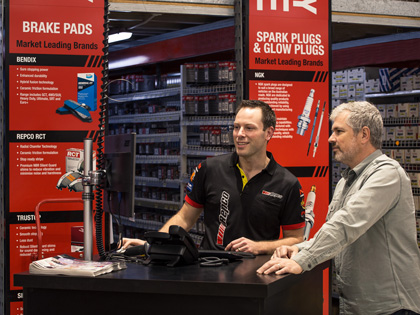
RACV Members save everday on auto parts at Repco
All RACV-accredited Auto Care Centres (AACCs) commit to:
- delivering services efficiently and responsibly under the supervision of competent and qualified staff
- maintaining the highest standards of quality and professionalism
- providing a written estimate of repair costs for labour and materials on request
- seeking express authorisation if the cost of the repair work is likely to exceed the estimate by 10%
- performing duties with honesty and integrity
- continually striving to improve the quality of service
- guarantee the effectiveness of repairs under normal operating conditions for 12 months or 20,000km (whichever occurs first).
All claims under this guarantee must be notified to your RACV-accredited Auto Care Centre within the expiry of the guarantee period. For more information, please contact your RACV-accredited Auto Care Centre.
All RACV AACC repairers provide a replacement warranty in respect of parts on the basis that all new, remanufactured and reconditioned parts installed will be covered by a minimum of 12 months or 20,000km, whichever occurs first, free-of-charge replacement warranty in respect of manufacturing faults (and in each case, abuse, physical damage or neglect will void the warranty).
RACV Members receive a 30-day mechanical guarantee on all vehicle inspections, subject to the following conditions:
- The guarantee is only available to current RACV Members.
- Members can make a claim under the guarantee for an eligible mechanical fault up to the limit of $1,000 for pre-purchase inspections or $2,000 for comprehensive inspections.
- The guarantee excludes any items repaired after the vehicle inspection; consumables (such as engine oil, coolant, brake fluid, tyres, lighting and batteries); pre-existing faults identified as Observation, Early, Immediate or Warranty in the vehicle inspection report; and any item covered under a valid dealer statutory warranty and any non-mechanical items including body work.
- The mechanical fault must have occurred within 30 days from the date of the vehicle inspection ("the Guarantee Period") to be eligible.
- The Member must notify the RACV-accredited Auto Care Centre where the vehicle inspection was completed ("The Inspecting AACC") within 7 days of the expiry of the Guarantee Period and prior to having any repair work carried out.
- All repairs must be authorised by RACV or the Inspecting AACC prior to any repair work being carried out and all repairs must be done by an approved RACV-accredited Auto Care Centre ("the Repairer") within 30 days of the repairs being authorised.
- The Member must pay the Repairer for the full cost of the repairs and submit the statement of work and paid invoice to the Inspecting AACC.
- The Inspecting AACC will review the statement of work and paid invoice and will reimburse the Member for the cost of repairs of an eligible mechanical fault up to the value of $1,000 for pre-purchase inspections or $2,000 for comprehensive inspections.
The information provided is general advice only. Before making any decisions please consider your own circumstances and the Product Disclosure Statement and Target Market Determinations. For copies, visit racv.com.au. As distributor, RACV Insurance Services Pty Ltd AFS Licence No. 230039 receives commission for each policy sold or renewed. Product(s) issued by Insurance Manufacturers of Australia Pty Ltd ABN 93 004 208 084 AFS Licence No. 227678.