Confused about what to do at a yellow traffic light in Victoria? Learn the road rules, common mistakes, and what the law says about stopping versus going.
Motoring
Guide to road line markings in Victoria: what do they mean?
Being a safe driver requires an understanding of the different line markings on Victorian roads. Here are the road symbols and markings all motorists need to know.
Line markings are one of the simplest and most important road safety measures used on roads in Australia. These markings separate and guide traffic, helping ensure the safety of all road users.
"Road infrastructure such as line markings keeps traffic moving smoothly and safely, as well as help protect vulnerable road users such as pedestrians and bike riders" says RACV's Head of Policy, James Williams.
"Failing to understand the line markings on the road can lead to confusion, dangerous driving and even collisions."
It’s important to note that while there is an Australian standard for road markings, some variations can exist between states.
For more information, visit RACV’s page on line markings in Victoria.
In this article
The different types of road line markings in Victoria
Dividing lines
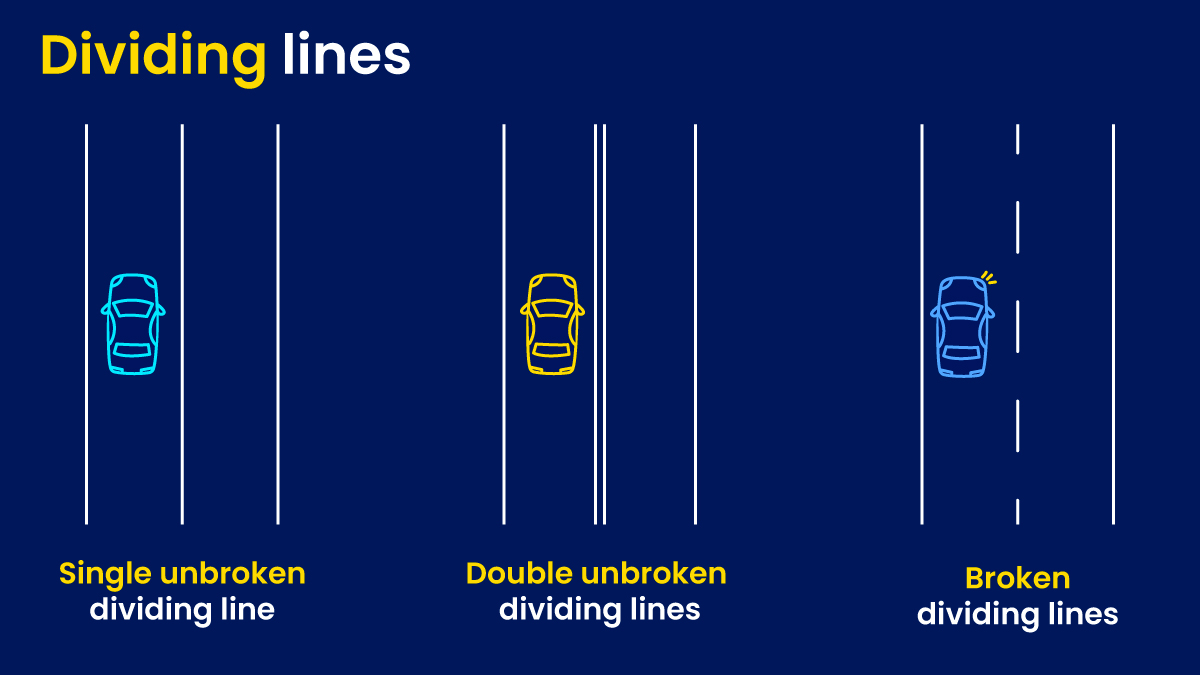
Dividing lines separate traffic going in opposite directions. The specific type of dividing line, as noted below, provides further instruction to motorists on whether they can cross these lines.
Single unbroken dividing lines
Motorists can cross a single, unbroken dividing line to enter or leave the road, or to overtake someone riding a bike (as long as it is safe to do so and there is a clear view ahead).
You cannot cross a single, unbroken dividing line to overtake vehicles or do a U-turn. To park opposite a single, unbroken dividing line you must have at least three metres clearance (between the line and your vehicle) and a sign specifying that parking is allowed.
The above rules also apply to a broken line to the right of a single unbroken line.
Double unbroken dividing lines
You can only cross double unbroken lines to avoid an obstruction on the road or to overtake a person riding a bicycle (so long as it is safe to do so and you can clearly see ahead).
You cannot cross double unbroken lines to overtake other motor vehicles, make a turn or to enter or leave the road.
Broken dividing lines
Motorists can cross both single and double broken dividing lines to enter or leave the road, overtake, or do a U-turn (provided it is safe, the road ahead is clear and all other road rules are followed).
The above rules also apply to a broken line to the left of an unbroken line.
Related reading: Everything you need to know about merging, overtaking and keeping left on Victorian roads.
Dividing lines separate traffic going travelling in opposite directions. Types include single unbroken, double unbroken and broken.
Lane lines
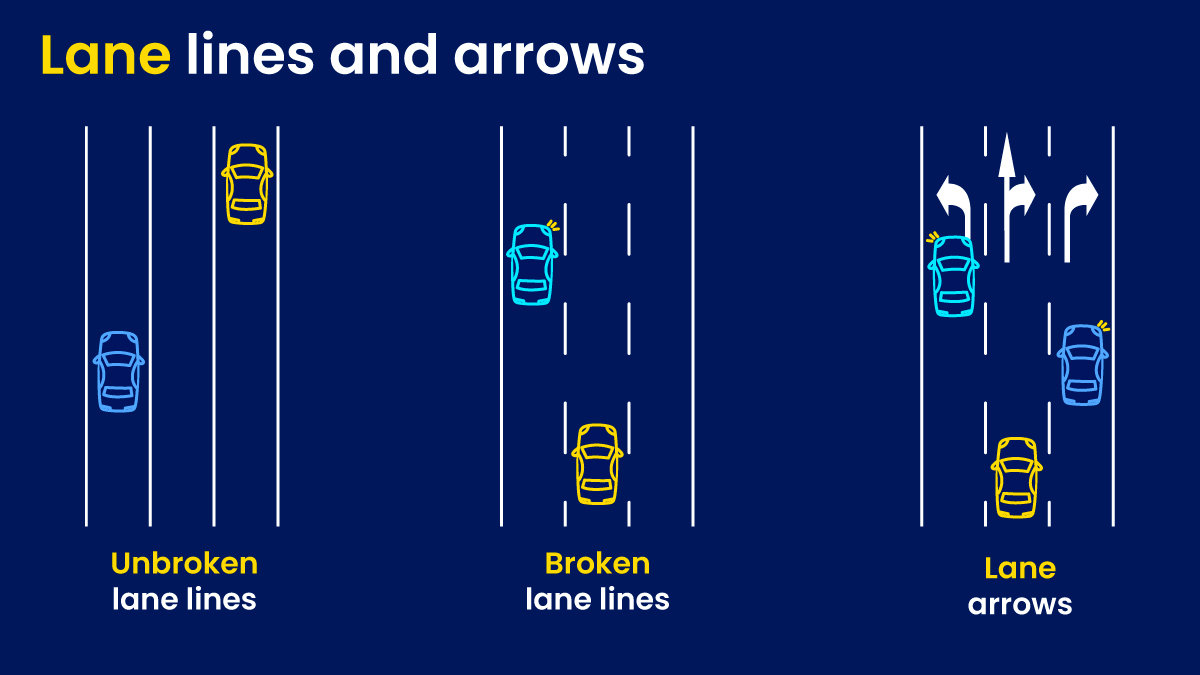
Lane lines separate multiple lanes of traffic travelling in the same direction.
Unbroken lane lines
Generally speaking, you cannot cross continuous, unbroken lane lines to change lanes. However, you can cross these lane lines if:
- A sign says you can
- You are driving a special type of vehicle allowed in the lane you’re changing into (e.g. a bus driving in a bus lane)
- You’re avoiding an obstruction on the road (this does not include overtaking vehicles travelling slowly or stopped in traffic)
- You are overtaking a bike rider (as long as it is safe to do so).
Broken lane lines
Motorists can cross over broken lane lines to change lanes, as long as it’s safe to do so. You must indicate and not exceed the speed limit when changing lanes.
What if there are no lane or dividing lines?
Some multi-lane roads do not have marked lanes. That is, there are two or more lines of traffic moving in the same direction, but not lane lines on the road surface.
In this instance, you can still change between each lane of traffic so long as you indicate before changing, and it is safe to do so.
Motorists driving on a road without a dividing line or median strip to separate opposite directions of traffic must keep to the left of the centre of the road.
What do yellow line markings on the road mean?
Unbroken yellow lines on the edge of a road indicates a no stopping area, with motorists who stop within the area marked by the yellow edge line liable to be fined.
A broken yellow edge line can indicate parking or no stopping restrictions, but you may be able to stop on one depending on other factors. Always refer to other signs and markings present, or park elsewhere if unsure.
Double unbroken yellow lines are also a common sight across metro Melbourne where they are sometimes used to indicate a tramway. Tramways must not be driven in by motorists, unless they need to cross the tram tracks (provided it is safe and within all other road rules to do so).
Read more: What to know about driving with trams in Melbourne.
Lane lines separate traffic moving in the same direction but typically only unbroken lane lines can be crossed.
Other road line markings and symbols Victorian drivers must know
Painted traffic islands
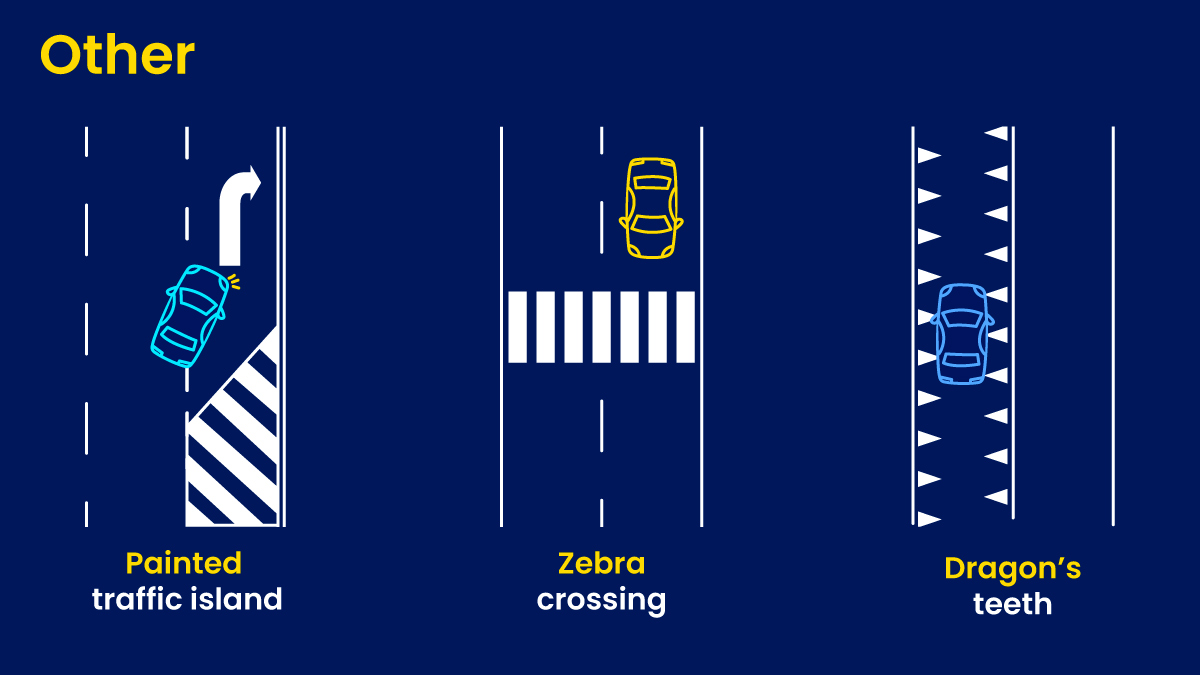
Painted traffic islands are striped, irregularly shaped patches of road that assist with traffic separation and direction. There are restrictions about when motorists are permitted to drive on such traffic islands, and incorrectly doing so has been flagged as one of the most common bad habits of drivers in Victoria.
You cannot drive on a painted traffic island surrounded by a single, continuous line except when:
- For up to 50m before entering or leaving the road
- For up to 50m before entering a turning lane that begins immediately after the traffic island
- Accessing angle parking on the opposite side of the road.
Painted traffic islands on freeway on-ramps or slip lanes must never be driven over.
Related reading: The rules about merging, speed and breakdowns on Victoria's freeways.
Traffic lane arrows
Traffic lane arrows indicate to motorists the direction traffic in that lane can travel.
Motorists must drive in the direction(s) indicated by the traffic arrow in any lane they are travelling in. Where the traffic arrow points in more than one direction, motorists can travel in any of the directions indicated (and signal accordingly).
Drivers in Victoria are also able to make a U-turn from lanes marked with a right turn arrow, as long as there is no sign prohibiting the manoeuvre.
It's important motorists understand and obey road markings such as traffic islands, zebra crossings and dragon's teeth.
Road markings for bike riders and cyclists
When travelling on the road, including in bike lanes, bike riders must obey all road rules and road markings.
Bike riders must also use dedicated bike lanes where they exist, unless it’s not practical or safe to do so.
Bike lanes are identified by bike symbols along the length of the lane and are separated from vehicle lanes with a dividing line. This is often a single, unbroken dividing line but some roads may use continuous, double white lines with bars between them. Some bike lanes are also painted green, especially where bike, vehicle and pedestrian traffic may intersect.
Motorists must not drive in or cross bicycle lanes unless they are:
- entering or leaving a road
- passing a vehicle turning right or making a U-turn
- entering another traffic lane
- entering a parking space
- pulling over or parking.
Drivers can only enter a bike lane for up to 50m for any of the above listed exceptions. Take great care, indicate, and check your blind spots when crossing a bike lane.
Drivers can cross single, double or single yellow lines to safely overtake a bike rider. Remember that when passing a bike rider motorists must keep at least one metre from riders on roads with a speed limit of up to 60km, and 1.5 metres distance if travelling over 60km.
Read more: What are the rules about wearing a helmet in Victoria?
Pedestrian road markings
Zebra crossings
These are pedestrian crossings that are easily identified thanks to the thick white lines that span the width of the road (like a zebra’s pattern).
Motorists, bike riders and e-mobility users must all give way to a pedestrian crossing or waiting to cross at a pedestrian crossing, such as a zebra crossing.
There are also ‘wombat crossings’ which combine a speed hump with a pedestrian crossing. These crossings should be treated the same as zebra crossings – slow down when approaching and give way to all pedestrians crossing or waiting to cross.
Related reading: Pedestrian road rules in Victoria
Zigzags
Zigzags are typically used on roads approaching pedestrian crossings. They serve to warn motorists that a crossing is ahead and that they should slow down (and stop if necessary for pedestrians).
Dragon’s teeth
Rows of triangles on each side of a lane are known as dragon’s teeth. These road markings are commonly seen on the approach to school zones to remind motorists to slow downs and stay alert. They can also be used on other sections of road that may be hazardous.