
Strong demand for EVs has brought sharper prices for electric cars and SUVs, with many now below $40,000. Chinese brands are leading the charge: BYD, Geely, Jaecoo, GWM, MG, Chery, Leapmotor and others. Here are the cheapest EVs you can buy in Australia right now.
Electric

Should I get an EV or a home solar battery first?
Buying an electric vehicle or solar battery can reduce your bills but deciding which to invest in first can be a tricky decision. Here’s how to choose.
Australians are increasingly embracing electric vehicles and solar batteries. The Australian Automobile Association reported that almost half of new light vehicle sales in the June 2026 quarter were electric or hybrid. Battery electric vehicles reached a record 21.03 per cent market share, while plug-in hybrids reached a record 10.58 per cent.
Home solar batteries are also gaining momentum, helped in part by the federal government’s Cheaper Home Batteries program. The Clean Energy Council reports that there were 454,473 solar battery units installed across Australia at the end of 2025, as well as a four-fold increase in battery installations across Australia in the six months following the commencement of the Cheaper Home Batteries program (compared to the same period the year prior).
But while the financial benefits of both technologies are well documented, the upfront costs mean many households may need to choose one before the other.
So, which should you buy first? To help you answer that question we’ve compared the costs and benefits of EVs and solar batteries.
Try RACV’s free electrification calculator to estimate your savings when going electric.
In this article
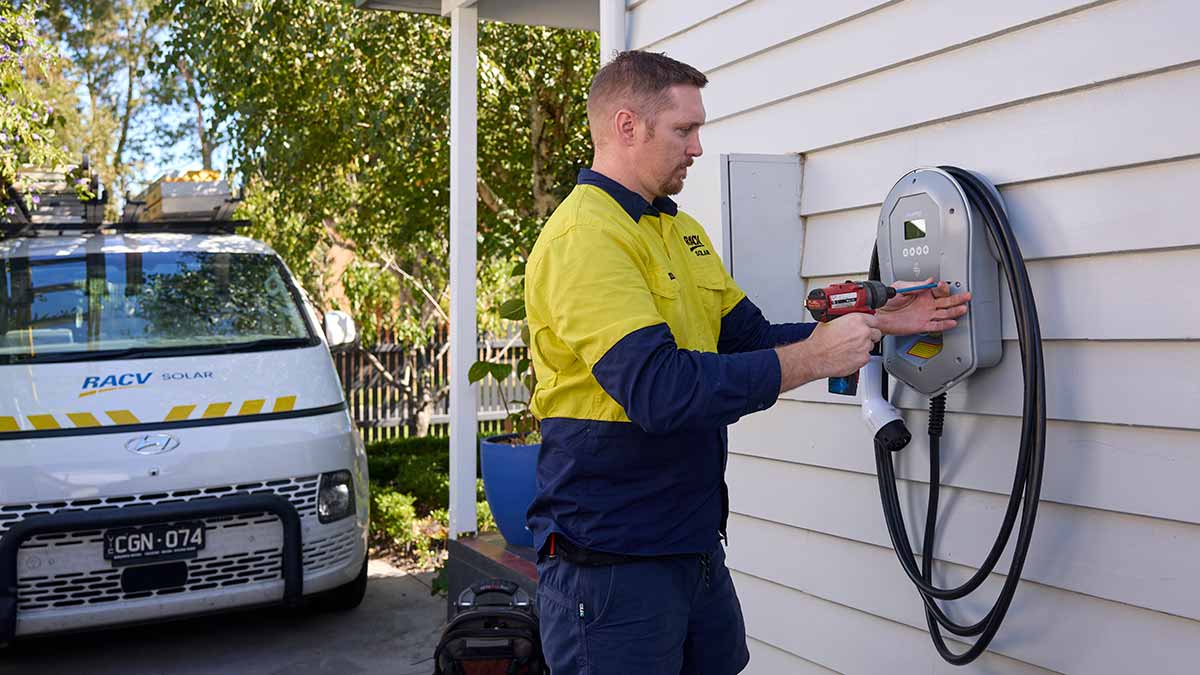
Home EV charger installation is often considered when buying an electric vehicle.
Why get an EV or solar home battery?
EVs and solar home batteries are both technologies helping drive the electrification of Australian homes.
They can both help reduce household running costs and emissions, but how they do so, and how effective they can be, is highly dependent on individuals and their lifestyles.
What problem do you want to solve?
I want to reduce fuel costs
For motorists who drive a lot and want to reduce their fuel costs, an EV may be the better technology to prioritise.
The Department of Climate Change, Energy, the Environment and Water estimates that an average car travelling around 13,700km per year can save between $1,000-$1,200 on fuel costs driving an electric vehicle.
Fuel costs may be reduced further through the use of a home solar PV system, off-peak tariff, or Victorian Midday Power Saver (available from October 1, 2026 - contact your electricity provider for more information).
I want to reduce home electricity costs
If you’re aiming to minimise your home electricity bills then installing a home solar battery could be the better option for you.
Solar batteries work by storing excess electricity generated during the day, allowing you to use it (or feed it back into the grid) at night-time when demand is highest and supply is lowest.
Installing a solar battery at home can also be useful for households wanting more energy security and a backup electricity supply in case of a power outage.
Solar batteries can help provide households with energy independance, especially in blackout-prone areas.
Cost comparison: EVs vs solar batteries
EV Costs
New EVs start at around $25,000 plus on-road costs in Australia, with electric SUVs starting at $31,990 plus ORCs. Finance options, including green loans, can help you buy an EV by spreading the cost over time through repayments. Alternatively, a novated lease allows eligible employees to make repayments from their pre-tax salary, and that has the potential to reduce your taxable income and result in a tax saving.
In addition to the upfront purchase price, you should also factor in how you’ll be charging your new EV when calculating total costs. Charging at home will generally be cheaper than at a public charging station, especially if you have solar panels or a battery installed where clever planning can see you charge for free.
The savings from an EV are typically more immediate compared to a solar home battery.
Australia’s Electric Vehicle Council calculates that swapping to an EV can reduce your cost per kilometre by 80 per cent a year (based on the average Australian motorist driving 12,000km per year and spending $2,500 on petrol).
The discount on registering an EV in Victoria ended in January 2026.
Read more: The cheapest EVs you can buy in Australia.
Do EVs cost less in maintenance than ICE vehicles?
It’s hard to definitively say that EVs cost less in maintenance costs than petrol or diesel vehicles.
However, EVs do have a less complex powertrain with fewer moving parts, and typically use fewer fluids to operate, so maintenance spending in those areas can be less.
With fewer components requiring routine attention, EVs can take less time to maintain – potentially reducing servicing costs. Where a conventional service schedule might be as frequent as every six or 12 months, some EVs only have a 24-month service interval.
Expect to spend more on tyre replacement, as electric vehicles are often fitted with specially tuned, low-rolling resistance tyres, which can be more expensive to replace.
Find out more about the differences in servicing costs between EVs and ICE vehicles.
Bidirectional charging can allow some EVs to be used like a solar battery, but the technology isn't widely available in Australia just yet. Image: Matt Harvey.
Solar home battery costs
Solar home batteries purchased through RACV Solar start from around $7,000. You’ll also need to factor in the cost of solar panels if you don’t already have them installed.
All batteries sold through RACV Solar come with a 10-year product warranty, as well as a 5-year warranty on installation.
Solar Victoria estimates that ideally a solar home battery will pay for itself within 10 years.
What if I’ve already got solar panels?
Having a pre-existing solar PV system in place will benefit you regardless of whether you opt for an EV or solar home battery first.
For EV owners, solar panels can help them reduce the charging costs of their vehicle, especially if they’re able to charge their vehicle during the day.
And since solar panels are a necessity for solar home batteries, having them already installed can help you save on some upfront costs when installing a battery.
The rebates available for EVs and solar home batteries
Rebates and incentives for EVs
Victoria has not offered an EV purchase subsidy since 30 June 2023. Eligible EV owners can still receive a $100 registration rebate, which is automatically applied at renewal and shown on your renewal notice. Other states and territories may offer additional incentives.
At a federal level, the main incentive is the Electric Car Discount, which exempts eligible EVs from Fringe Benefits Tax (FBT) and certain import charges, helping reduce the cost to employees when vehicles are provided through a novated lease.
Learn more: Electric vehicle rebates, discounts and incentives in Australia
Rebates for solar batteries
You can access rebates for solar home batteries through the federal government’s Cheaper Home Batteries program.
Learn more: Rebates for solar products in Victoria.
Can an EV replace a home battery?
Theoretically, yes. Some EVs are capable of bidirectional charging. This is where the EV can supply power back into a home (or the electricity grid), in addition to taking power from the home or grid to power itself.
In homes that have a solar PV (panel) system installed, EVs with bidirectional charging can even be used like a solar battery by absorbing excess electricity during the day and feeding it back to the property at night.
However, this technology is still in its infancy in Australia, with very few bidirectional charging-capable EVs available in the local market.
Learn more: Bidirectional charging in Australia.
Final verdict: should you get an EV or solar home battery first?
Deciding whether to get an EV or home solar battery first is a deeply individual question determined by your personal circumstances and where you’re hoping to make the most savings.
Get an EV first if:
- You drive a lot
- You want to save on fuel costs
- You want more immediate savings.
More: Research and compare electric cars in Australia
Get a home solar battery first if:
- You want energy independence and have blackout protection
- You want to reduce your home energy costs
- You already have solar panels.

