
Ensure your dog's safety and comfort when driving and parked by following these road and animal welfare laws.
Car Safety
The most misunderstood road rules in Victoria
From U-turns to passing stationary trams, here are some of the most misunderstood road rules in Victoria. Road laws are constantly being reviewed and updated, so it's important to keep up to date.
Even if you've been driving for 20 years without incident and never made a car insurance claim, you might not be as clear about Victorian road rules as you might think. New road rules are added regularly, while old rules can be updated.
Here are some of the road rules and regulations that have been known to confuse even the most experienced drivers.
Jump to
- Road rule 79a update
- Hook turns: who can use them and when
- Merging lanes: who really has right of way
- School zones: when reduced speeds apply
- Hands-free mobile phone use in vehicles
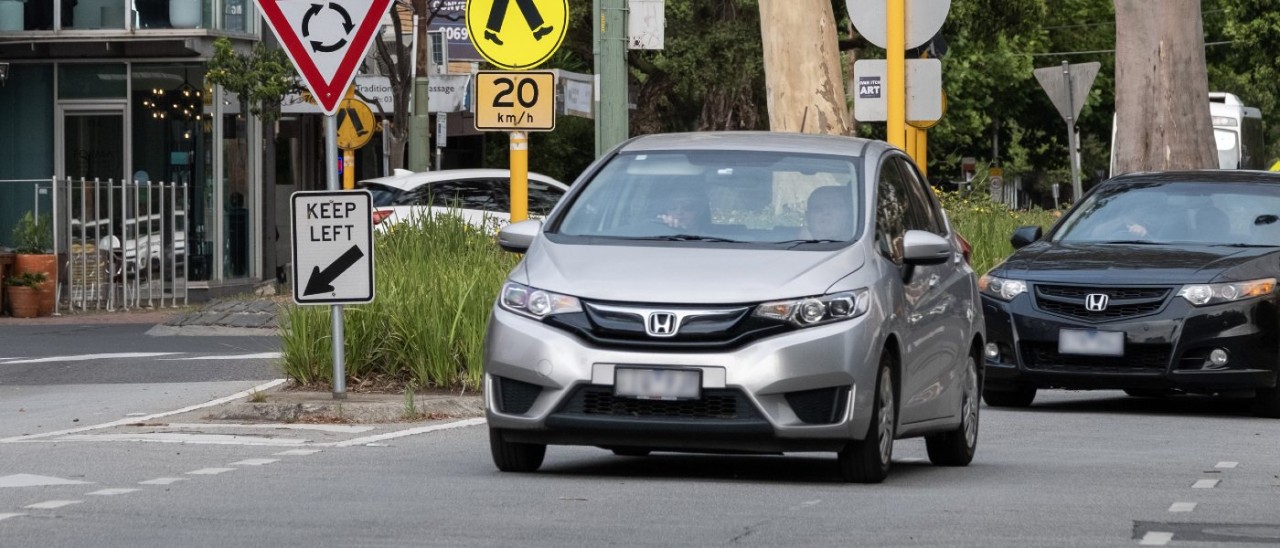
- Roundabouts: indicating and giving way
- Turning right at traffic lights without arrows
- U-turns: when they are allowed
- Passing stationary trams
- Yellow lights: continuing versus stopping
- Reversing out of driveways
Road Rule 79A update
Last year, RACV successfully campaigned for the Victorian government to update Road Rule 79A to help protect emergency roadside assistance workers, tow truck drivers and their customers - in addition to police and first responders.
Common misunderstanding
Some drivers think they don't have to slow down for all incident response vehicles.
The rule
Drivers on Victorian roads must slow down to 40km/h per hour when passing or overtaking:
- stationary or slow-moving roadside assistance
- accident towing
- breakdown towing
- all incident response service vehicles displaying a flashing blue, red, magenta or yellow light.
This is an expansion of Victorian Road Rule 79A, first introduced in 1 July 2017, that mandates drivers slow down to 40km/h when approaching and passing any slow-moving or stationary police, emergency, enforcement, or escort vehicles displaying flashing red, blue, magenta or yellow lights or sounding an alarm.
The explanation
This rule update helps safeguard emergency workers, first responders and roadside assistance employees and customers from incidents.
Hook turns: who can use them and when
Hook turns are one of Melbourne’s most distinctive road rules and one of the most confusing for both locals and visitors.
A hook turn is used at certain intersections, usually in the CBD, to allow right-turning vehicles to wait on the left side of the road before completing their turn when the traffic lights change.
Common misunderstanding
Some drivers believe hook turns are optional.
The rule
If there is a 'Hook Turn Only' sign, drivers must perform a hook turn. You cannot make a standard right turn at these intersections unless signage explicitly allows it.
Drivers must:
- enter the intersection from the left lane
- position their vehicle as far left as possible
- wait until the lights on the road they are turning into turn green
- complete the turn when it is safe to do so.
Failing to follow hook turn rules can result in fines and increased congestion.
The explanation
Hook turns are designed to keep traffic flowing and prevent right-turning vehicles from blocking trams.
Merging lanes: who really has right of way
Lane merging causes daily frustration on Victorian roads, particularly during peak hour or roadworks.
Common misunderstanding
Some drivers think the vehicle in front always has right of way.
The rule
Where the vehicles cross a dashed line, like on a freeway entry ramp, the vehicle crossing the line must give way to cars already in the lane.
A 'zip-merge' occurs when two lanes of traffic join and there's no dashed line in between. In this case:
- if one vehicle is clearly ahead, it goes first
- if vehicles are alongside each other, the vehicle changing lanes must give way
- courtesy merging is encouraged, but not required by law.
The explanation
Understanding this rule can reduce sudden braking, sideswipe crashes and aggressive driving caused by uncertainty.
School zones: when reduced speeds apply
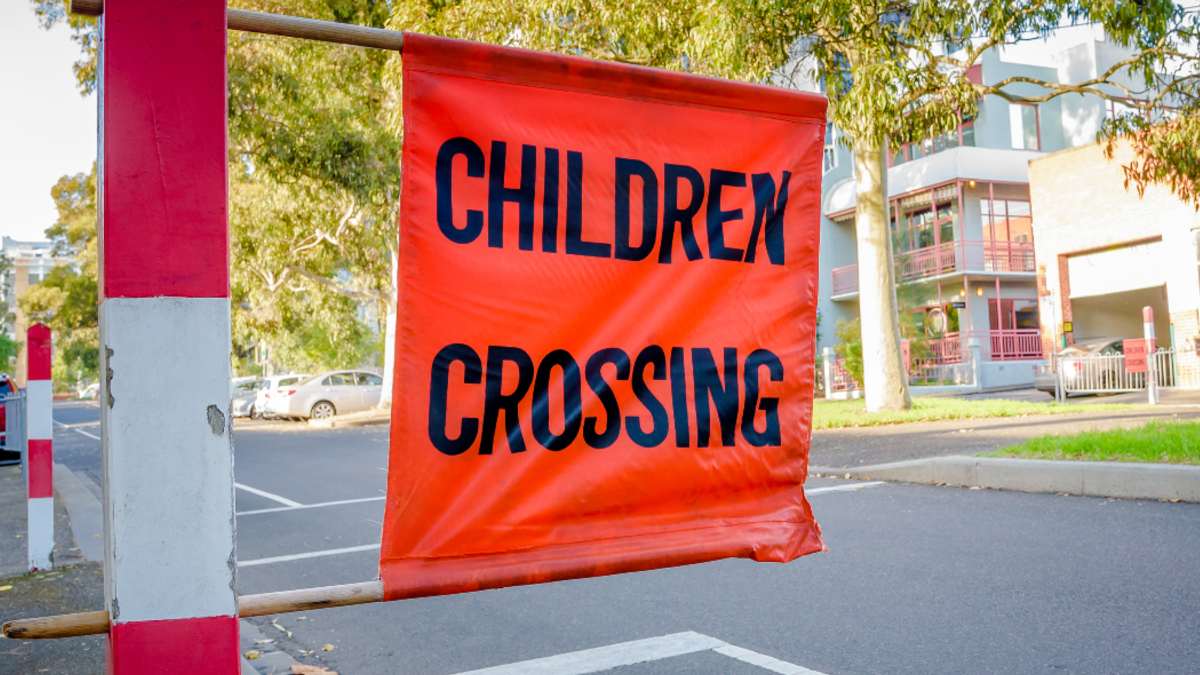
School zones are critical for child safety, yet speed limits in these areas are often misunderstood.
Common misunderstanding
Some drivers think school zone speed limits only apply when children are present.
The rule
In Victoria, most school zones operate at 40km/h on school days between specific hours, typically 8-9.30am and 2.30-4pm.
The reduced speed applies regardless of whether children are visible. Flashing lights, signs or electronic displays often indicate when the limit is active.
The explanation
Children can behave unpredictably near roads, and lower speeds significantly reduce the severity of injuries if a collision occurs.
Be aware around school zones and reduce your speed to match the road rules. Image: Getty
Hands-free mobile phone use in vehicles
Mobile phone rules in Victoria are among the most robust in Australia.
Common misunderstanding
Some drivers think they can touch their phone if it's unmounted. Other drivers think that Learner, P1 and P2 drivers may use voice control or hands-free mobile functions.
The rule
Fully licensed drivers
Mounted devices: Fully licenced drivers are allowed to use their mounted mobile phones for making or receiving calls, navigation and playing audio using hands-free or voice control functions, while driving.
Touching a mounted device: Fully licenced drivers are only allowed to briefly (a couple of seconds) touch their phone for changing a song or volume, adjusting navigation or answering a call - and only if the mobile phone is mounted.
Unmounted devices: If the mobile device is unmounted, fully licenced drivers must set up their navigation and music or audio, and put their mobile device out of reach and sight, before they begin driving. They may not use their mobile device for anything else, even answering calls.
Learner, P1 and P2 drivers
Mounted devices: Learner, P1 and P2 drivers must set up their mounted mobile devices for navigation, music or audio before commencing their journey. To change a song, the volume or an address in the navigation system, these drivers must safely pull over and park.
Touching a mounted device: Learner, P1 and P2 drivers must not touch their device at any point while driving, even at a traffic light. Using hands-free or voice control functions is not permitted either.
Unmounted mobile devices: Learner, P1 and P2 drivers must not have any ongoing activity, such as navigation or audio, playing on an unmounted mobile device while they are driving.
The explanation
Distraction is a major contributor to crashes. Even brief phone interaction significantly reduces reaction time and hazard awareness.
Roundabouts: indicating and giving way
Roundabouts are another major source of confusion for Victorian drivers.
Common misunderstanding
Some drivers believe indicating is optional at roundabouts. Others believe that you only have to give way on the right.
The rule
In Victoria, drivers must give way to any vehicle already in the roundabout, as well as any trams entering or approaching the roundabout. In most cases, those vehicles already in the roundabout will be on your right. However, in some cases, such as smaller roundabouts, vehicles that have entered to the left or on the opposite side of the roundabout may mean you cannot safely enter and have to give way, as they are already in the roundabout.
Before entering, indicate as you normally would – left to turn left, right to turn right, no indicator if you're going straight. If you're leaving the roundabout more than halfway around, indicate right.
When you exit the roundabout, indicate left if practicable.
The explanation
Clear signalling helps other drivers, cyclists and pedestrians anticipate movements and prevents collisions.
Turning right at traffic lights without arrows
Intersections without right-turn arrows often confuse drivers.
Common misunderstanding
Some drivers aren’t sure how far into the intersection they should move when waiting to turn right. This can lead to vehicles stopping too far back, or positioning themselves in a way that puts them in the path of a tram or in the path of opposing traffic that is also turning right.
The rule
When turning right at lights without a dedicated arrow, drivers are allowed to enter the intersection on a green light and wait until oncoming traffic clears. Once the light turns yellow or red, drivers who are already in the intersection must complete the turn when safe.
When turning right at an intersection without a turn arrow, always look for pedestrians crossing the street you’re turning into and give way to them.
Giving way to an emergency vehicle
If you're in the path of an emergency vehicle displaying flashing red or blue lights or sounding an alarm, move out of its path as soon as you can do so safely. If you're stopped, remain stationary until it's safe to proceed. This rule applies despite any other rule that would otherwise require a driver of a police or emergency vehicle to give way to you.
The explanation
Failing to understand right-of-way at intersections can reduce traffic flow and increase congestion.
U-turns: when are they allowed?
U‑turn rules vary depending on location, line markings and signage.
Common misunderstanding
Some drivers believe U‑turns are always illegal at intersections or traffic lights. This isn’t the case in Victoria.
The rule
In Victoria, you can make a U‑turn unless:
- a ‘No U‑turn’ sign is displayed, or
- it would be unsafe to do so.
This applies at:
- intersections without traffic lights, and
- intersections with traffic lights — Victoria is the only Australian state where this is permitted by default.
When making a U‑turn, you must always give way to all other vehicles and pedestrians.
Where U‑turns are not permitted
You must not make a U‑turn at:
- a children’s crossing,
- a pedestrian crossing, or
- a level crossing — with or without traffic lights,
unless a ‘U‑turn permitted’ sign is displayed.
Road markings and signs that prohibit U‑turns
You must not make a U‑turn where there is:
- a single continuous centre line,
- double continuous centre lines, or
- a ‘No right‑hand turn’ sign.
U‑turn rules when driving interstate
In all other Australian states and territories, U‑turns at intersections with traffic lights are permitted only where a ‘U‑turn permitted’ sign is displayed.
The explanation
These rules allow U‑turns where visibility and safety permit, and prohibit them where risk is higher.
Passing a stationary tram
Victoria's tram network introduces unique road rules that can surprise drivers.
Common misunderstanding
Most Victorian drivers know they must stop when a tram stops, with the car level with the rear of the tram, to allow passengers to get on and off safely. But what about if there are no passengers about?
The rule
Drivers must always stop when:
- a tram has stopped and passengers are boarding or alighting
- tram doors are open or warning lights are flashing
- there is no safety zone (area with safety zone signs and a traffic island or dividing strip) separating passengers from traffic.
If a tram is stopped in a safety zone, a driver may drive to the left of the safety zone at a speed that is safe for pedestrians who may be crossing the road.
Once the doors have closed and there are no pedestrians crossing the road, you can drive past the tram at 10km/h or slower. These rules apply to all road users, including cyclists.
The explanation
These rules protect tram passengers who may need to step directly onto the road.
Yellow lights: continuing versus stopping
Yellow traffic lights are one of the most misunderstood signals on Victorian roads.
Common misunderstanding
Some drivers think that a yellow light means 'speed up before it turns red'.
The rule
A yellow light means stop, unless it's unsafe to do so. Drivers should not accelerate to beat the red light.
The only reason you should not stop at a yellow light is if you are so close to the intersection that braking is likely to either cause an accident, or cause you to come to a stop in the middle of the intersection.
The explanation
Yellow lights provide a warning period to stop safely, reducing the risk of high-speed crashes at intersections.
Reversing out of driveways
This everyday manoeuvre is sometimes misunderstood.
Common misunderstanding
Among the stream of queries and questions RACV receives, every so often someone will write in insisting that it's illegal to reverse out of a driveway.
The rule
Reversing out of a driveway is legal in Victoria. Drivers must reverse slowly and give way to pedestrians, cyclists and vehicles on the road or footpath.
When vision is impeded, drivers are allowed to use their horn to alert surrounding people to the position of their vehicle. Luckily, the rise of reversing cameras and rear cross traffic alert technology is set to increase reversing safety.
The explanation
The rule encourages drivers reversing from private property do so cautiously and responsibly.
The information provided is general advice only. Before making any decisions please consider your own circumstances and the Product Disclosure Statement and Target Market Determinations. For copies, visit racv.com.au. As distributor, RACV Insurance Services Pty Ltd AFS Licence No. 230039 receives commission for each policy sold or renewed. Product(s) issued by Insurance Manufacturers of Australia Pty Ltd ABN 93 004 208 084 AFS Licence No. 227678.

