We've recently reviewed and updated our Privacy Charter, which describes how we use cookies and other technologies to understand and improve your browsing experience. By using our site, you agree to us collecting this information and to our Privacy Charter.
You’ll be sent the latest news, exclusive offers and competitions to your inbox.
Electric
2026 Kia PV5 Cargo and 2027 Kia PV5 Passenger: price, specs and release date in Australia
RACV
September 08, 2026
Kia is shaking up the traditional delivery van and people-mover segments in Australia with the all-new electric PV5 Cargo and Passenger. Here’s an in-depth guide to these two new EVs.
Kia is drawing a lot of attention in Australia’s fast-growing electric light-commercial van market with the 2026 Kia PV5 Cargo – and will follow this up with a seven-seat people-mover spin-off, the 2027 Kia PV5 Passenger.
With an accessible price point, strong technology package and a claimed 416km (WLTP) driving range, the Kia PV5 Cargo makes a compelling case for business users in a segment still dominated by diesel-powered vans, while the 2027 Kia PV5 Passenger is set to offer similar advantages as it slots in as an EV alternative to the top-selling Kia Carnival MPV.
Here’s a comprehensive guide to both Kia PV5 models, with full details for the PV5 Cargo and what to expect from the PV5 Passenger ahead of its local launch.
The Kia EV5 Cargo is priced from $55,990 plus on-road costs, making it an affordable EV alternative to diesel vans.
When does the Kia PV5 go on sale in Australia?
The 2026 Kia PV5 Cargo is now on sale in Australia, marking Kia’s debut in the electric light-commercial van segment and some two decades since the Korean brand last competed in this category – with the long-forgotten, diesel-powered Kia Pregio.
An official release date for the 2027 Kia PV5 Passenger has not yet been announced, but the seven-seat electric people-mover did receive homologation approval in late August 2026, paving the way for its release Down Under later this year or early in 2027.
How much does the Kia PV5 cost?
The 2026 Kia PV5 Cargo is available in a single model variant, priced from $55,990 plus on-road costs – or $61,394.07 drive-away for Victorian private buyers.
Kia’s price point for the PV5 Cargo is also not far away from its major diesel competitors, with the Hyundai Staria Load starting from $49,990 plus ORCs (add $3500 more for the hybrid) and the top-selling Toyota HiAce LWB van selling from $51,880 plus ORCs.
No Australian price has yet been released for the 2027 Kia PV5 Passenger, but its nearest stablemate, the eight-seater 2027 Kia Carnival, starts from $54,560 plus ORCs for the S Diesel. The Carnival HEV petrol-electric hybrid is also available from $56,310 plus ORCs, while the brand’s seven-seat electric family SUV, the Kia EV9, starts further upstream at $97,000 plus ORCs.
Like the PV5 Cargo, we expect the PV5 Passenger’s pricing to make it a strong consideration next to traditional combustion-engined people-movers. It should also undercut premium Chinese electric MPVs like the Denza D9 (from $85,990 plus ORCs) and Xpeng X9 (from $89,900 plus ORCs), along with the Volkswagen ID. Buzz Pro seven-seater (from $80,990 plus ORCs).
Scheduled services for the Kia PV5 Cargo are required every 30,000km or two years, whichever comes first, although Kia says that more frequent intervals will be required if the vehicle is operated “in severe usage conditions”. Prepaid servicing plans are available for one service ($528), two services ($1090), three ($1650) or four ($2246).
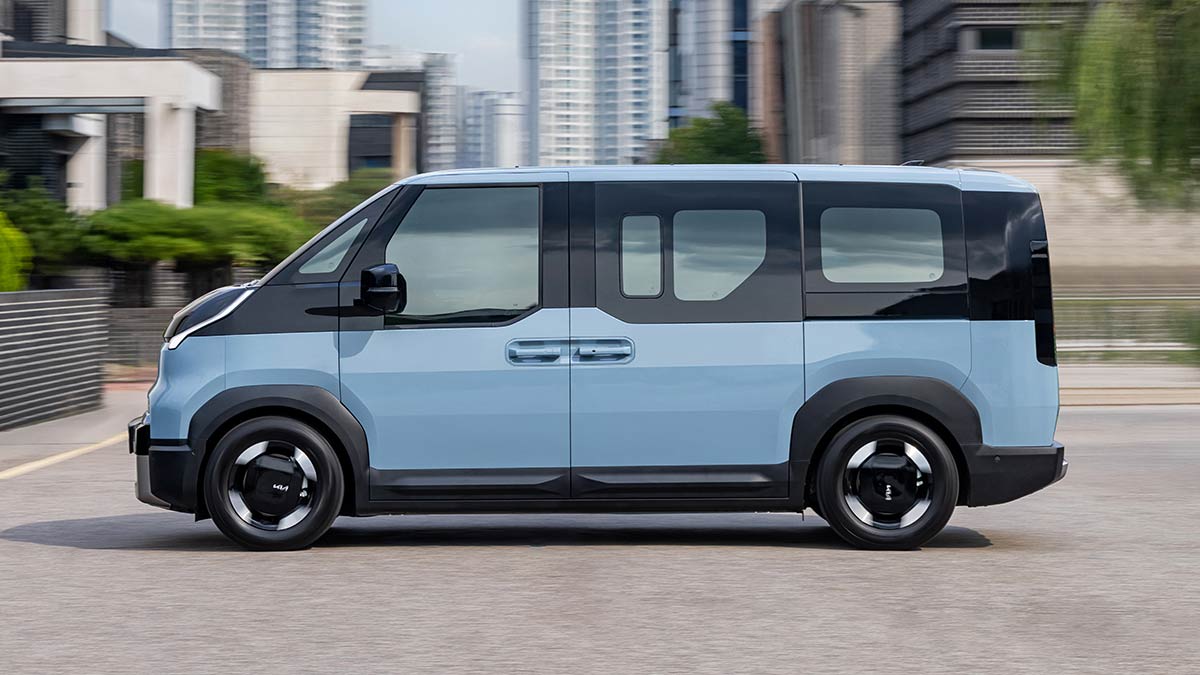
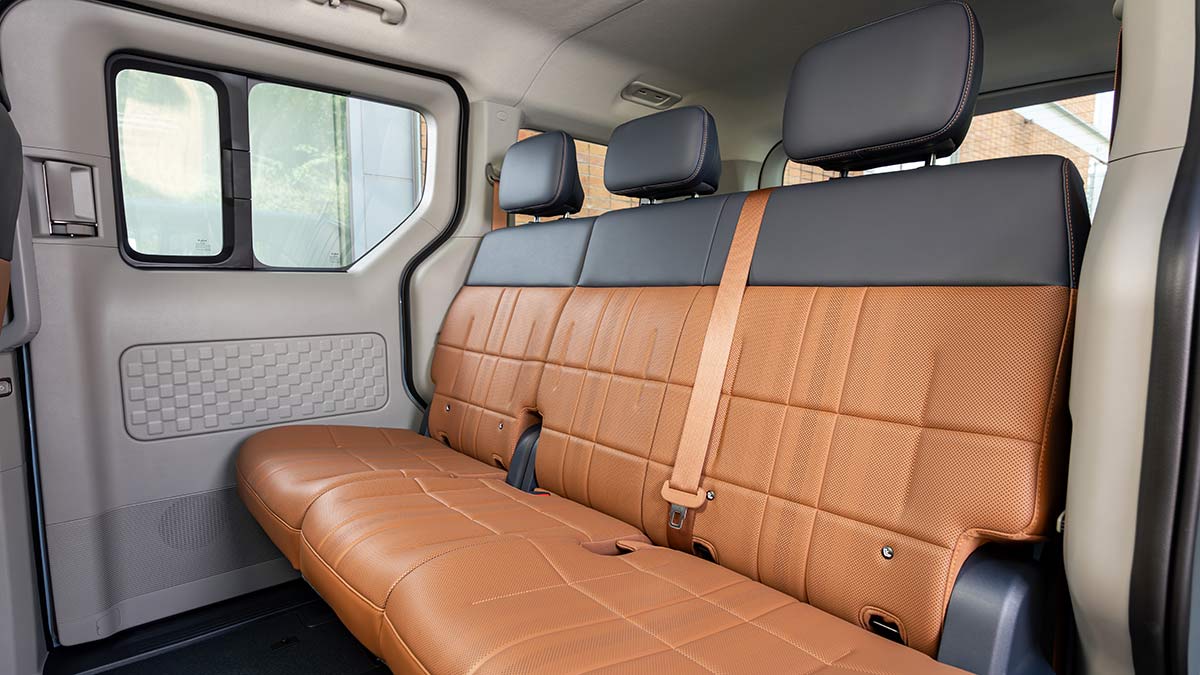
The Kia PV5 Passenger will seat up to seven occupants in Australia.
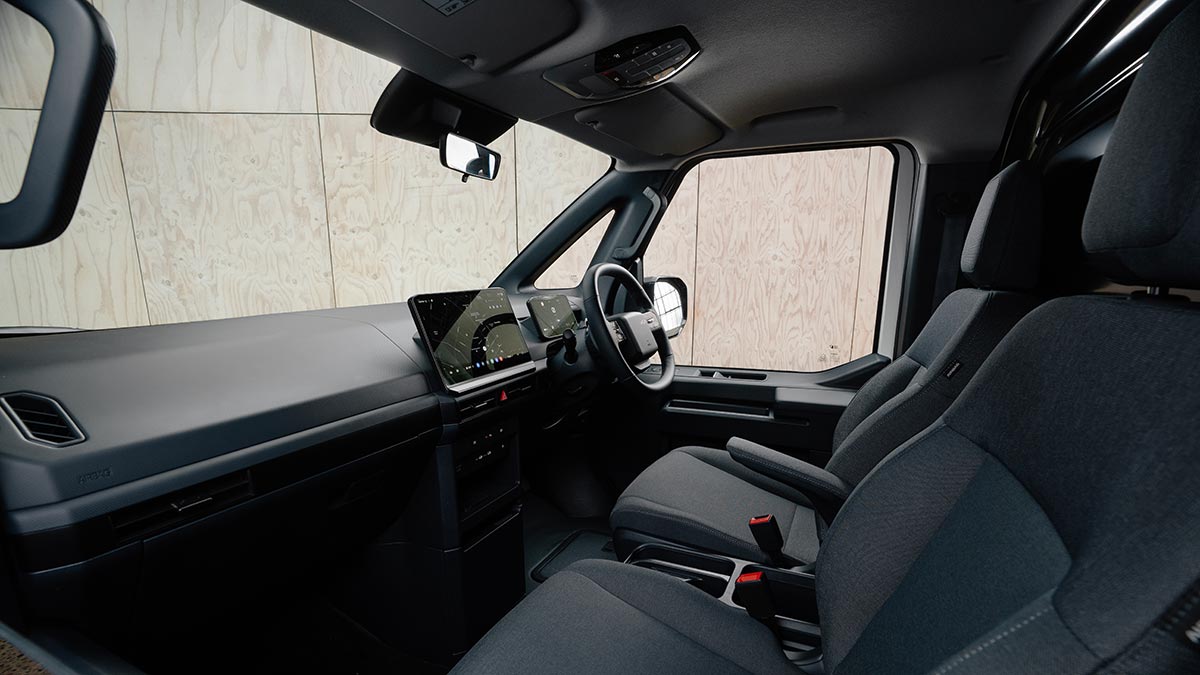
The Kia PV5 Cargo has two bucket seats as standard in a typical van cabin layout.
Sliding doors aid ingress and egress to Kia PV5 Passenger rear seats.
1 of 3
How many seats does the Kia PV5 have?
The 2026 Kia PV5 Cargo is a two-seater only at this stage in Australia, with no three-seater front bench or five-seater dual-cab configuration available.
The 2027 Kia PV5 Passenger is sold around the world with a variety of seating options, but homologation approval documents filed in Australia reveal that Kia is planning to offer the electric people-mover as a seven-seater only from launch.
What is the power and range of the Kia PV5?
The 2026 Kia PV5 Cargo is designated a ‘Long Range’ variant with a single-motor/front-wheel drive layout and 71.2kWh lithium-ion battery. Based on regulatory documents, the 2027 Kia PV5 Passenger will have the same configuration.
The electric motor produces maximum power of 120kW and torque of 250Nm. For the PV5 Cargo, the high-voltage battery enables a claimed 416km driving range, based on the WLTP standard. The driving range should be similar for the PV5 Passenger, depending on its final specification for our market.
Both EVs are based on Kia’s E-GMP.S platform, designed specifically for electric commercial vehicles. The company says E-GMP.S maximises drivetrain efficiency, while the front-wheel drive layout means the vehicle can achieve the lowest possible floor height by eliminating the need for a driveshaft to the rear wheels.
Charging times for the PV5 vary depending on whether alternating current (AC) or direct current (DC) charging is used. DC fast charging up to 350kW is available, at which point Kia says the battery can be charged from 10-80% in approximately 30 minutes. AC charging at a maximum 11kW can replenish the battery from 10-100% in six-and-a-half hours, according to the carmaker.
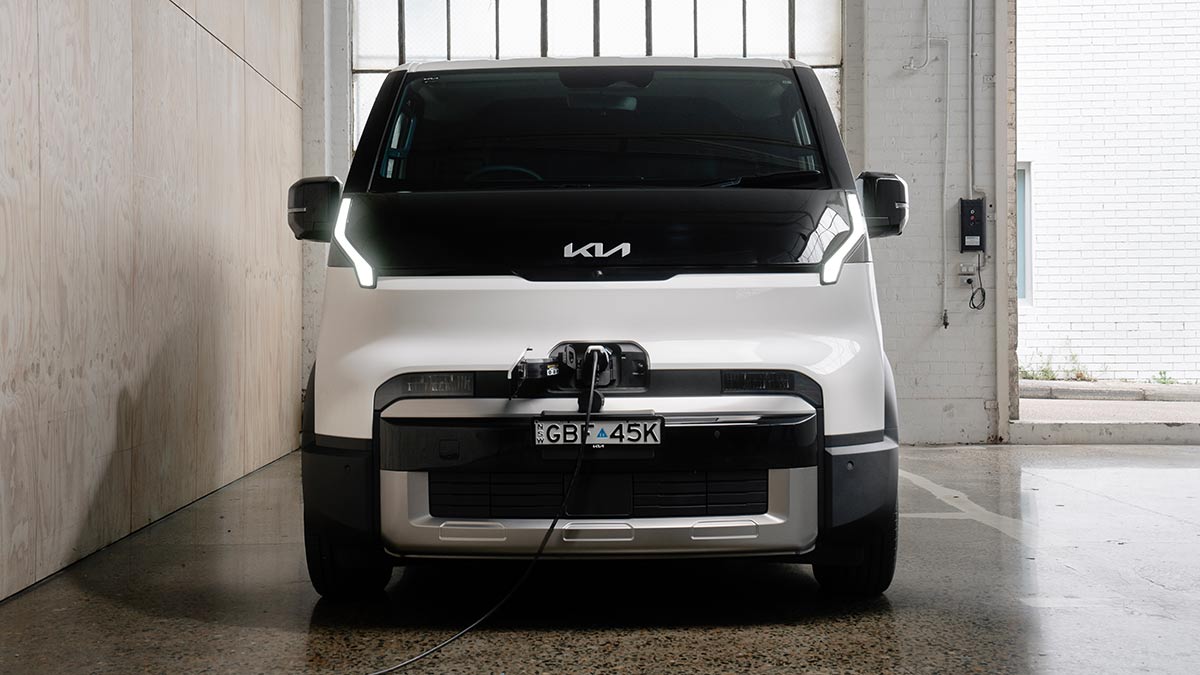
The charge port is at the front of the vehicle and uses the common Type 2 connector for AC charging and CCS2 for DC charging.
The Kia PV5 can handle DC charging up to 350kW, or AC charging up to 11kW.
Kia PV5 exterior design, dimensions and specs
The 2025 Kia PV5 Cargo slots into the medium-sized van segment, measuring 4695mm long, 1895mm wide and 1899mm high. It rides on a 2995mm wheelbase and has a 143mm minimum ground clearance.
This footprint strikes a balance between interior capacity and manoeuvrability, making the PV5 Cargo well suited to urban environments while retaining useful load-carrying capability, according to Kia. On the latter, however, load capacity is on the low side at 4.42 cubic metres (more detail on this below).
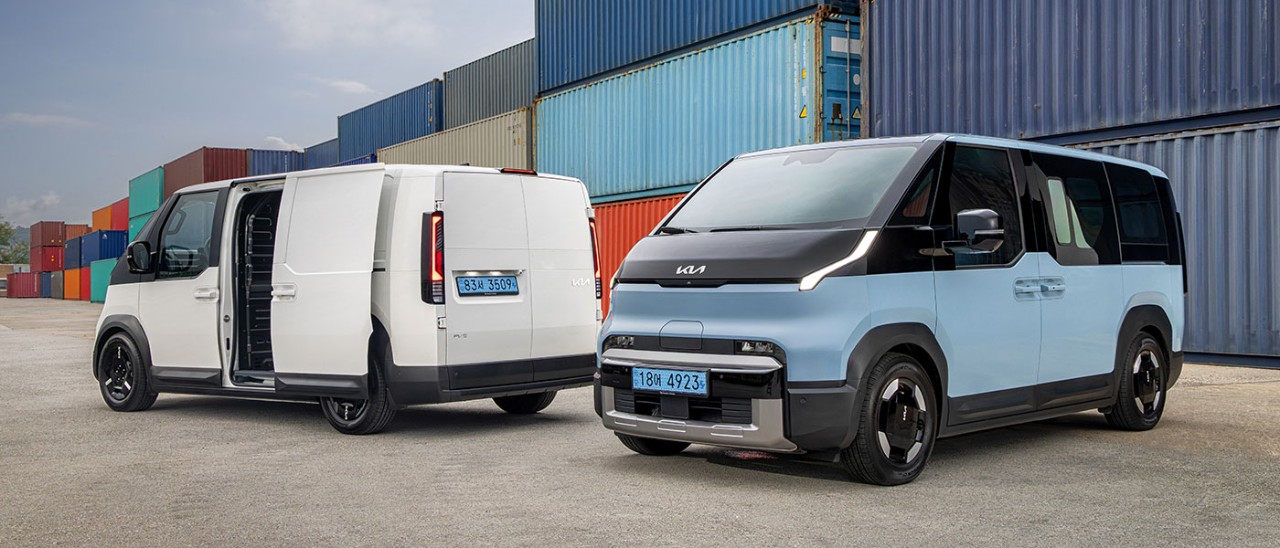
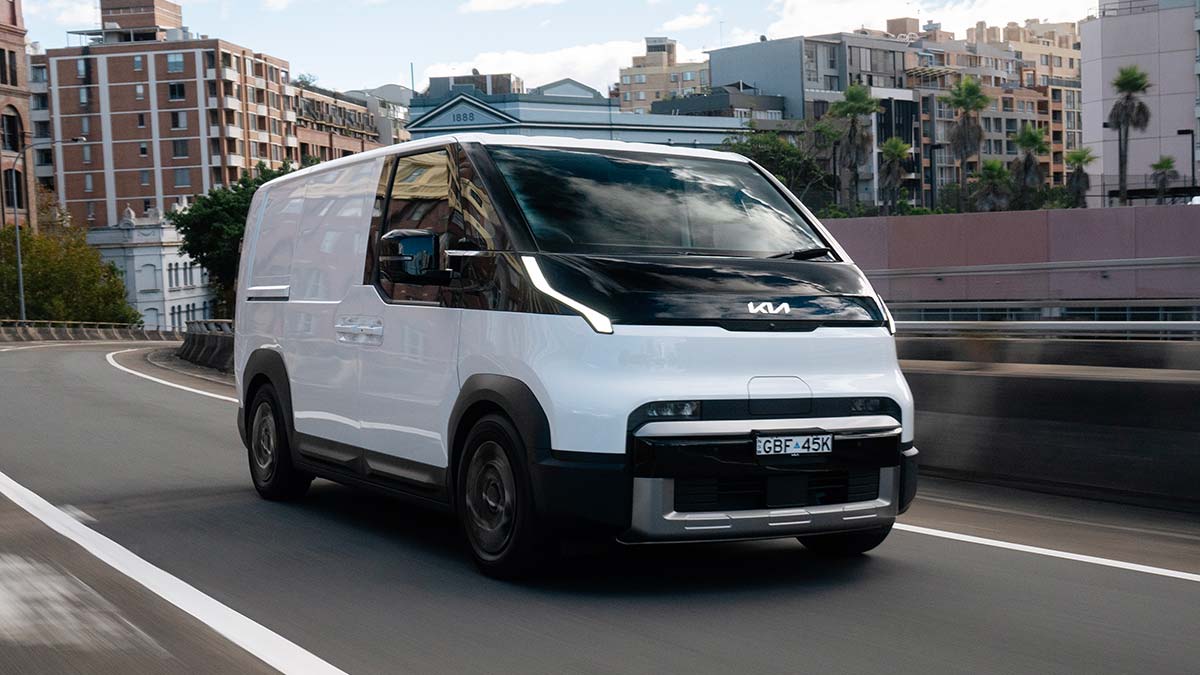
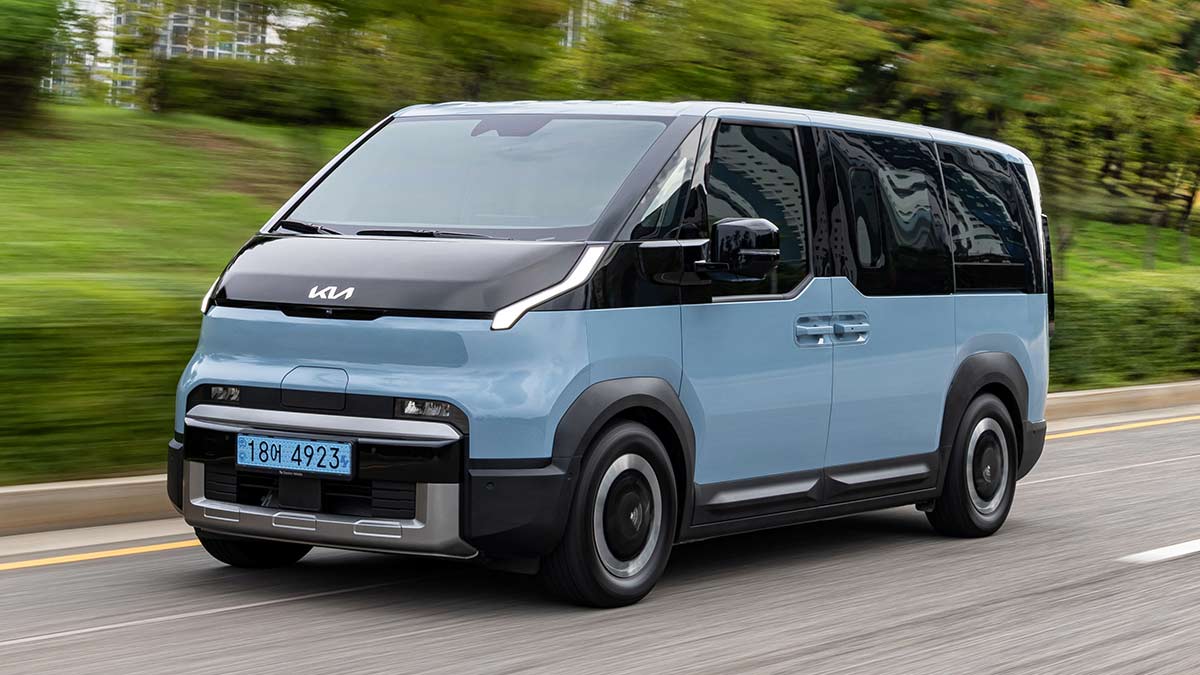
Looking clean and modern, the PV5 Cargo is only available in white body colour. Its so-called ‘Tiger Face’ styling at the front of the vehicle is framed by LED daytime running lights that extend into the front pillar, while the side profile has a typically boxy silhouette and highlights the 16-inch geometric wheel cover design that reinforces the vehicle’s practical purpose.
At the rear, Kia’s signature ‘Star Map’ lighting, including its tall vertical tail-lights, stands out in traffic and provides a modern finishing detail, ensuring the PV5 Cargo looks similar to other Kia vehicles. The Kia PV5 also has reflector-type LED headlights and tail-lights, the latter with bulb indicators, a rear fog light and a high-mounted LED stop lamp.
In Australia, the PV5 comes standard with sliding cargo doors on both sides of the vehicle to allow for easier access, even in narrow spaces. At the rear, it has split barn doors that swing 95 degrees for quick stops and 180 degrees for more intricate loading. At 419mm off the ground, the van’s low rear step is designed to help reduce strain on the knees and back and make repetitive loading safer, easier and more efficient.
The PV5 Cargo’s suspension comprises independent double wishbones up front and a torsion beam axle at the rear. The van has an 11.0m turning circle, electric power steering, front and rear disc brakes and 16-inch steel wheels as standard. There’s no spare wheel, instead relying on a ‘tyre mobility kit’ and tyre pressure monitoring system.
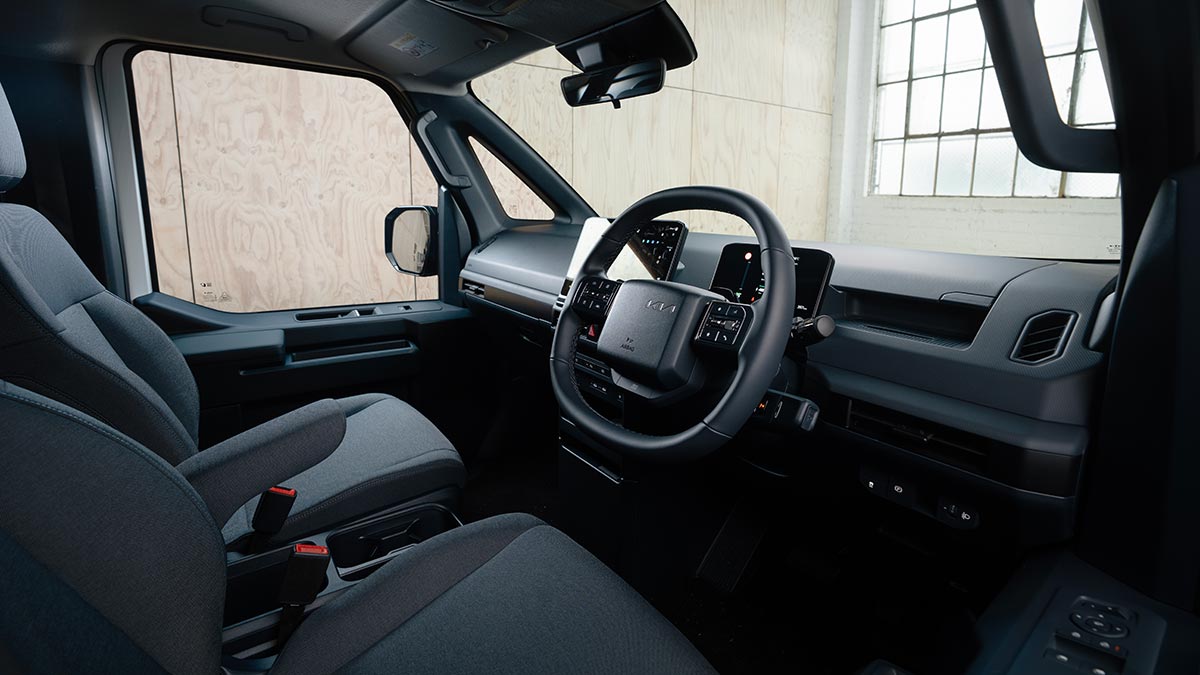
The Kia PV5 Cargo interior has twin bucket seats and a typically upright dash for a light-commercial van.
What is the Kia PV5 like inside?
Kia prioritised versatility, storage and connectivity features when designing the 2026 Kia PV5 cabin.
The PV5 Cargo features a sliding compartment beneath the centre fascia, which is big enough to store a range of documents, plus other storage trays under the floor, along the sides of the seats and in the dashboard.
The PV5 Cargo is only available with a Deep Navy interior colour scheme, with a grey cloth headliner, and boasts LED interior lighting in both the cabin and cargo areas. The driver and front passenger are provided with six-way manually adjustable seats (with cloth trim) and single-zone climate-control air-conditioning.
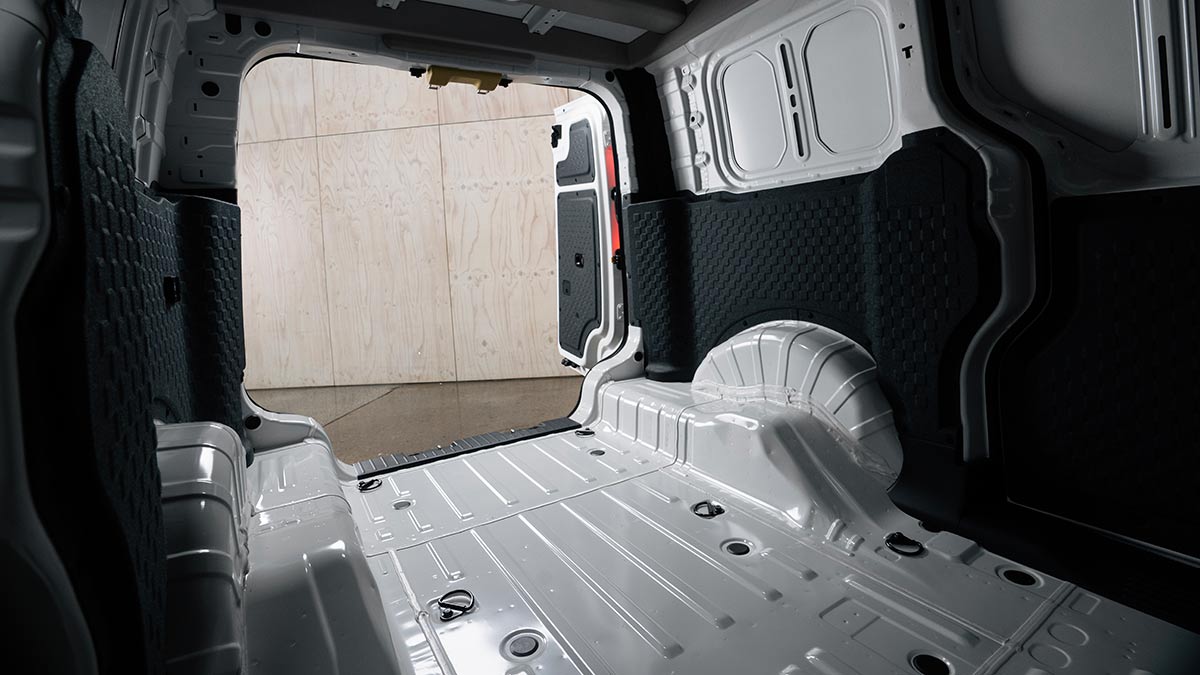
Separated from the cabin by a solid partition, the rear cargo area has eight tie-down points and side trims to shield the cargo walls from contact with boxes and pallets.
The Kia PV5 Passenger is said to offer one of the lowest floor heights in class, aiding accessibility for passengers. The step height at the side sliding doors is 399mm. Full specifications are still to be provided, although Kia has said the MPV offers luggage volume of up to 2615 litres (to the headlining) when the seats in both the second and third rows are folded.
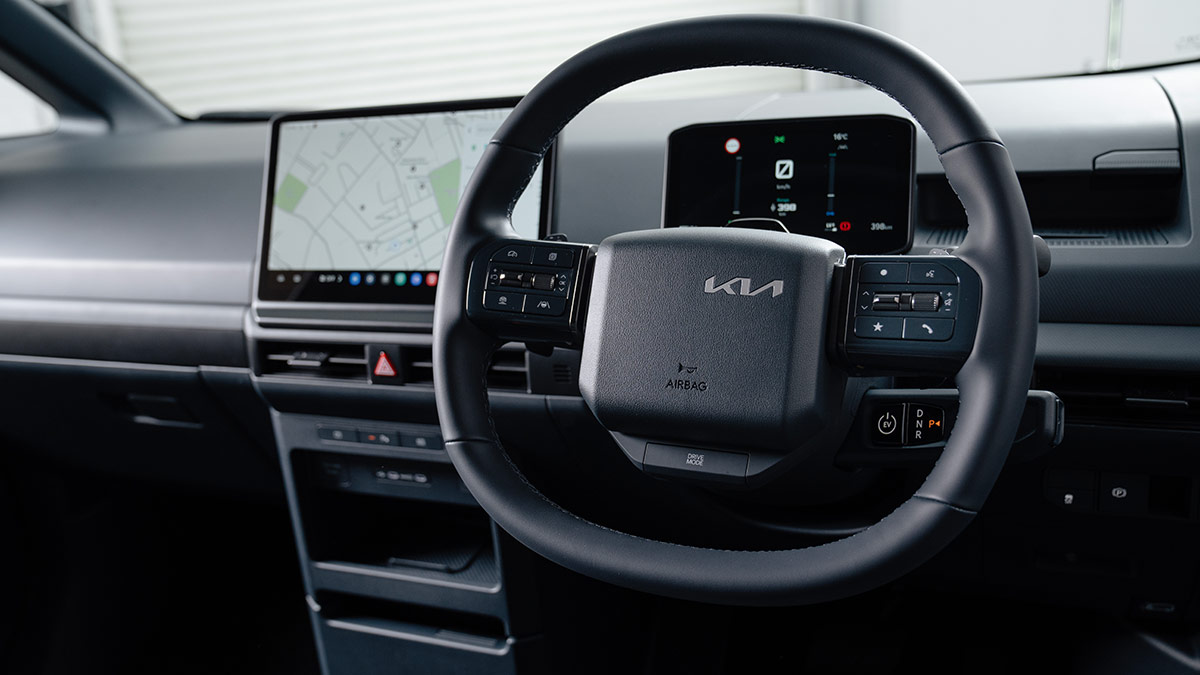
Dual digital screens are provided on the Kia PV5 Cargo sold in Australia.
What technology features on the Kia PV5?
The Korean manufacturer’s stated aim for the Kia PV5 is to redefine what businesses can expect from a modern van, and its range of standard technologies support this ambition.
The PV5 Cargo features a centrally positioned 12.9-inch infotainment display that integrates media and satellite navigation functions, while a 7.5-inch digital instrument panel is also provided. The PV5 has Android Auto and Apple CarPlay connectivity, both with voice recognition, as well as steering wheel-mounted audio and Bluetooth controls, two stereo speakers and AM/FM and DAB digital radio.
It also features a wireless phone charger and offers two vehicle-to-load (V2L) power sockets – one inside, and an adaptor for the exterior charging port.
The PV5 Cargo also has access to the Kia Connect telematics system, which is offered free for seven years – in line with the van’s factory warranty. The connected services allow drivers to use their smartphone to remotely track the vehicle’s real-time GPS location, lock, unlock and start the vehicle, adjust climate settings and monitor tyre pressure, fuel and battery levels.
The system also offers a local weather forecast, a map of nearby EV charging stations and the plugs available. And not least of all, Kia Connect enables important safety features such as automatic collision notification and emergency call (eCall).
Over-the-air (OTA) software updates are provided on the PV5 to improve key vehicle functions, including powertrain, steering, suspension, electric motor, battery, airbags and advanced driver assistance systems (ADAS).
Load area dimensions could be a make-or-break factor for those considering the Kia PV5 Cargo.
What is the Kia PV5 Cargo towing capacity and payload?
The 2026 Kia PV5 Cargo has a maximum 750kg braked towing capacity, with a 75kg maximum towball download. That’s down on key diesel-powered rivals such as the Toyota HiAce LWB, which can haul up to 1500kg with trailer brakes fitted.
The PV5 Cargo’s gross vehicle mass (GVM) is 2650kg and its kerb weight 1910kg, with a maximum payload of 740kg and a roof load of 100kg. So, it’s a sub-one-tonner that’s often cited as the benchmark for payload in the medium-sized delivery van class.
In comparison, the Farizon V7E has a maximum payload of 1338kg (GVM 3150kg) and the LDV eDeliver 5 delivers a 1200kg payload (GVM 3050kg). The Volkswagen ID. Buzz Cargo is closer to the PV5 Cargo in offering a 774kg payload (GVM 3000kg).
According to homologation documents filed with the Australian Government, the Kia PV5 Passenger will have a 2750kg GVM and 2200kg tare mass, along with a 750kg maximum braked towing capacity.
How much can the Kia PV5 Cargo carry?
As well as its modest 740kg payload detailed in the previous section, the 2026 Kia PV5 van has relatively modest cargo volume of 4.42 cubic metres – well down on most other medium-sized vans in this segment.
See the table below for a comparison in cargo dimensions and volume between the Kia PV5 Cargo and key competitors.
Vehicle
Cargo length (mm)
Cargo width (mm)
Cargo height (mm)
Cargo volume
(cubic metres)
Kia PV5 Cargo
2255
1565
1520
4.4
Farizon V7E
2865
1690
1435
6.9
LDV eDeliver5 SWB Low Roof
2654
1704
1455
6.6
VW ID. Buzz Cargo (tailgate)
2208
1732
1275
3.9
Hyundai Staria Load
2607
1640
1436
4.9
Toyota HiAce LWB (barn drs)
2530
1497
1340
6.2
Ford E-Transit Custom LWB
3050
1392 (b/w wheelarches)
1427
6.5
The Kia PV5 Passenger achieved only four stars under Euro NCAP without an optional safety pack fitted.
How safe is the Kia PV5?
Neither the Kia PV5 Cargo nor the Passenger version have been rated by ANCAP under its full assessment program, however the closely affiliated European NCAP has tested them both – with mixed results.
The Kia PV5 Cargo received a maximum five-star Euro NCAP safety rating in 2025, including 75% under the commercial vehicle ‘safe driving’ category, 80% for crash avoidance and 80% for post-crash safety.
What’s more, Australia’s ANCAP assessed the PV5 Cargo’s advanced driver assistance systems (ADAS) in its 2025 Commercial Van Safety Comparison , awarding it a Platinum safety grading with an overall 91% score. ANCAP testing showed the PV5 Cargo provided good levels of performance across the majority of autonomous emergency braking (AEB), lane support and speed assistance test scenarios. AEB reversing functionality is not available.
Euro NCAP assessed the Kia PV5 Passenger under its full 2025 testing protocols and awarded it a four-star safety rating. The MPV lost points in the absence of less well-performing crash avoidance systems, in particular protection against pedestrians at the rear of the vehicle, and against ‘dooring’ – where a door is opened into the path of a cyclist approaching from behind.
Additional radars that improve the PV5’s safety in these areas are part of an optional safety pack in Europe, which when fitted lifts the PV5 Passenger to a maximum five-star rating. It’s not yet clear whether Australian versions will have this safety equipment fitted standard.
In Europe, PV5 Cargo and Passenger models share the same ADAS. In Australia, the PV5 Passenger safety specs are still to be finalised, but the Cargo offers features such as:
AEB with junction turning
Surround view monitor with 3D mode
Blind spot collision avoidance assist
Rear cross traffic collision avoidance
Lane keep assist and lane following assist
Active cruise control
Safe exit warning
Driver attention monitoring
The PV5 Cargo is fitted standard with dual frontal airbags, as well as centre, side and curtain airbags.
As mentioned, the connected services suite includes an automatic collision notification and eCall system that provides assistance in the event of a serious collision.
The information provided is general advice only. Before making any decisions please consider your own circumstances and the Product Disclosure Statement and Target Market Determinations. For copies, visit racv.com.au. As distributor, RACV Insurance Services Pty Ltd AFS Licence No. 230039 receives commission for each policy sold or renewed. Product(s) issued by Insurance Manufacturers of Australia Pty Ltd ABN 93 004 208 084 AFS Licence No. 227678.
Want more articles like this?
Subscribe to RACV News for advice on cars, safety, home and travel.