
The electric Ford Transit City is now on sale in Australia, built in China and offered at a low price to threaten the Toyota HiAce and other traditional diesel vans. Here’s everything you need to know.
Electric
Why EV charging matters in regional Victoria
What to do if your EV runs out of charge or has a flat 12V battery
If your EV runs out of charge or has a flat 12V battery, here’s how to stay safe, find help and get moving again.
Running out of charge is one of the biggest concerns for drivers considering an electric vehicle, but it’s usually less dramatic than people expect. Like running low on petrol, it often comes down to route changes, charger availability or a simple miscalculation. There are, however, practical steps you can take to stay safe and get moving again.
But beyond individual actions, access to reliable charging infrastructure and roadside support also plays a key role in giving drivers confidence.
“For many motorists, the question isn’t just whether they want an electric vehicle, but whether they feel confident the infrastructure and support are there when they need it,” RACV Head of Policy James Williams says.
Electric vehicles reached 29.6 per cent of total new vehicle sales in May 2026 – the highest on record, according to the Electric Vehicle Council, taking the total number of EVs on Australian roads to more than 500,000.
“Practical support, from accessible charging to roadside assistance, plays an important role in making the transition feel easier," Williams says.
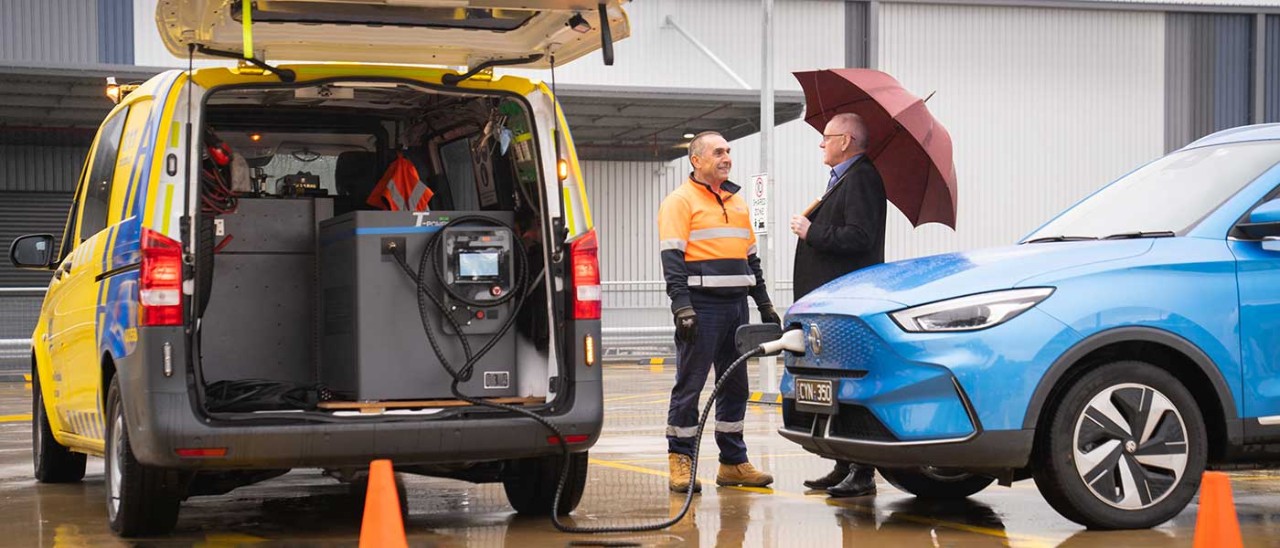
As more drivers make the switch, RACV Emergency Roadside Assistance is evolving too, with a new trial of mobile DC fast charging for stranded EVs.
More: Does your electric vehicle match its driving range claim?
Jump to:
Practical steps to take when your EV battery is critically low
Check if your EV can still reach a charging station
If your EV warns that the battery is critically low (known as a Low State of Charge (SoC) Warning), don’t ignore it. First, check whether a nearby charger is still within reach. Your car’s built-in navigation should be able to direct you to the closest compatible charging point. Reduce unnecessary energy use, if possible, and avoid sudden acceleration to help conserve charge.
Use an app to find nearby charging options
The RACV App can also help drivers locate nearby charging stations and plan their journey, which can be especially useful if you’re travelling in an unfamiliar area.
Use it to check whether there’s a compatible charger close enough to reach, and whether a short top-up could give you enough charge to continue to your next stop or make it home. If a charger isn’t safely within reach, it may be time to pull over and call for assistance.
Pull over safely if you can't reach a charger
If the car is about to stop, or has already stopped, your priority is to move to a safe location away from traffic if possible. Switch on your hazard lights and follow the same roadside safety precautions you would in any other breakdown. If you feel unsafe or are in immediate danger, call emergency services.
If you can’t safely reach a charger, roadside support is available. RACV Emergency Roadside Assistance is available for battery electric and hybrid vehicles. Your vehicle can be towed to the nearest accessible charging station, or to your preferred destination within your towing kilometre limit.
In other words, an out-of-charge EV is treated as a practical roadside issue, much like a flat tyre or lockout, with the aim of getting you moving again as quickly and safely as possible.
More: EV battery guide: types, capacity, charge levels, and safety
Chargefox's ultra-rapid charging stations enable faster charging speeds. Image: Shannon Morris
Fast roadside charging for EVs: what’s being trialled
A mobile DC fast charger is being trialled in one RACV Emergency Roadside Assistance patrol van, designed to help some stranded EV drivers get back on the road sooner. The 20kW on-board charger can provide about one kilometre of range per minute of charging, meaning that in as little as 20 minutes, drivers may gain enough charge to reach their next charging stop or get home safely.
RACV General Manager Automotive Services Makarla Cole says the trial reflects how roadside assistance is evolving as more Victorians switch to electric vehicles.
“As EV ownership continues to grow, we’re seeing a steady increase in out-of-charge callouts,” Cole says. “This trial is about looking ahead to what roadside assistance needs to deliver as more Victorians make the switch to electric vehicles.
“While traditional mobile charging solutions provide a small top-up, DC charging allows us to deliver a more meaningful boost in a shorter time, helping drivers get moving again sooner.”
More: Guide to electric vehicle charging, plug types and cables
Why EVs can run out of charge
Running out of charge doesn’t always come down to poor planning. In real-world conditions, a battery can drain faster than expected because of cold weather, freeway driving, heavy traffic, hilly roads, towing or carrying extra weight. On longer regional trips, it can also be harder to find a charger exactly when you need one, especially if infrastructure is less dense or a site is busy or unavailable.
That’s one reason range anxiety remains a sticking point for some drivers considering an EV, even as charging networks continue to expand. A recent Australian Automobile Association poll found 60 per cent of people who identify as likely EV buyers said concerns about vehicle range and recharging were the main hesitation stopping them from choosing an EV for their next purchase.
However, the Electric Vehicle Council’s 2025 EV Ownership Survey, based on responses from more than 1,800 EV owners, found those concerns fall sharply after purchase, along with worries about charging access and value.
More: Electric Vehicles in Australia: Complete buyer and ownership guide
How to reduce the risk of your EV running out of charge
A little planning can go a long way. Before a longer trip, map out where you’re likely to charge and build in a buffer rather than aiming to arrive with only a few kilometres of range left. It also helps to understand your vehicle’s real-world range, which can differ from the headline figure depending on your driving style, road conditions and the load you’re carrying.
If you’re heading away for the weekend or travelling through regional Victoria, check charger locations in advance and have a backup option in mind in case your first stop is occupied or out of service. Some public EV chargers (using AC) do not provide cables to connect the charger to your car, so it might be a good idea to carry your own in case of an emergency.
More: How to increase EV range: practical ways to extend your electric car’s range
Why EV charging matters in regional Victoria
For drivers in regional Victoria, or anyone heading off on a country road trip, running low on charge can feel more stressful simply because distances are longer and charging locations can be further apart. That doesn’t mean an EV can’t work well for regional travel, but it does mean route planning matters more.
“As EV adoption grows, expanding public charging will be critical to supporting motorists across Victoria, especially those travelling in remoter parts of the state,” Williams says.
As of early 2026, Australia had more than 5,000 public EV charging sites, comprising a mix of fast DC chargers and slower AC destination chargers.
RACV Members save at participating Chargefox ultra-rapid RACV charging stations

