
eCall can help save lives after an accident. Learn what eCall is, how crash detection technology works, and which car brands in Australia offer it.
Safety

The safest large utes and US pick-ups in Australia for 2026
How safe are American pick-ups and large utes that are popular among Australian buyers but can pose a threat to other road users? ANCAP has tested the crash avoidance tech of 5 top utes to find out.
American pick-up trucks are now a common sight on Australian roads, standing head and shoulders above regular traffic.
Often converted to right-hand drive through local remanufacturing programs, these hulking large utes from Chevrolet, Ram, Ford, Toyota and other brands meet the growing demand among tradies, fleets and families for a bigger and more capable towing and touring vehicle than what’s offered in the top-selling medium-sized ute class dominated by the Ford Ranger and Toyota HiLux.
However, the sheer size and greater mass of heavy-duty utilities – typically stretching around six metres long, 2m wide and 2m high, and all with a gross combination mass (GCM) of more than seven tonnes – has been raised as a concern for other motorists and road users, especially when driving in suburban streets and around schools.
“US pick-ups are no longer niche imports,” says RACV Head of Policy, James Williams. “As their numbers grow, it’s important to understand how their size, weight and design affect safety – not just for the people driving them, but also for other motorists, bike riders and pedestrians.”
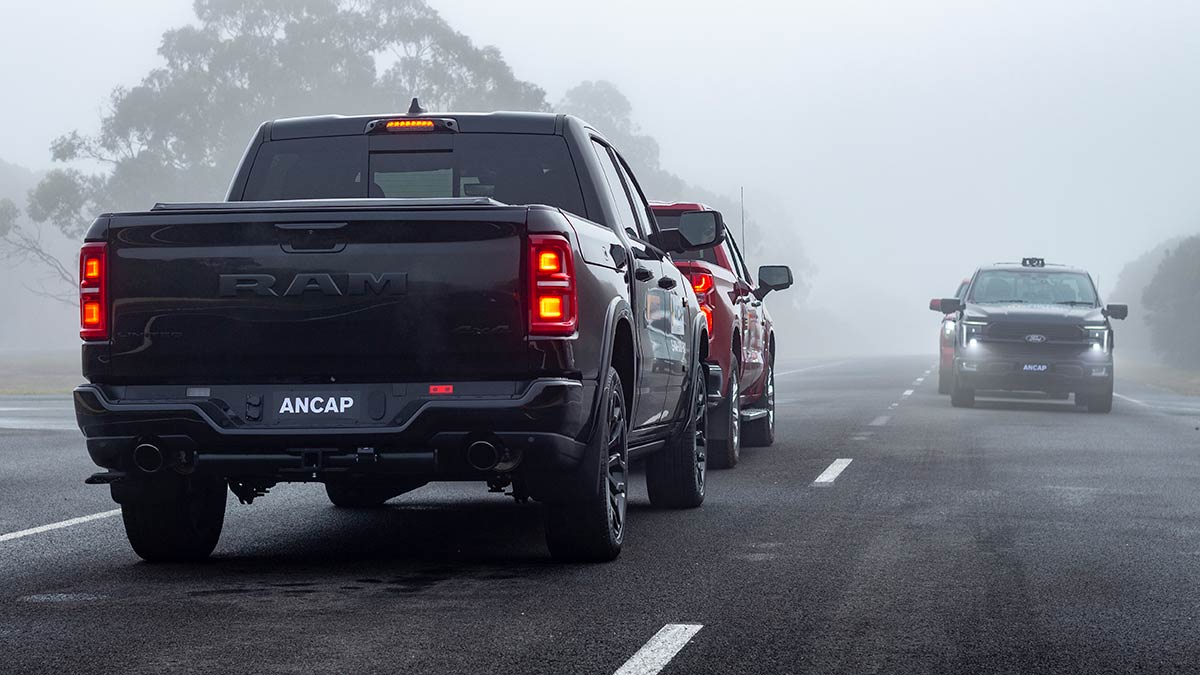
Taking a first step in this area, the Australasian New Car Assessment Program (ANCAP) has rounded up five popular large utes and US pick-ups in Australia and tested their crash avoidance technology to determine how well they protect those around them. The vehicles tested are:
More: Research and compare new cars, SUVs and utes on sale today in Australia
| Top 5 safest large utes / US pick-ups | ||
|---|---|---|
|
1. Ford F-150 |
81% |
Platinum |
|
2. Ram 1500 |
70% |
Gold |
|
3. Toyota LandCruiser 70 Series |
55% |
Silver |
|
4. Toyota Tundra |
50% |
Silver |
|
5. Chevrolet Silverado 1500 |
27% |
Bronze |
The increasing presence of pick-up trucks in Australia has heightened community concern, particularly for pedestrian and bike rider safety.
The testing process
In this study, ANCAP focused on the interaction of large pick-ups with other vehicles and vulnerable road users – pedestrians, cyclists and motorcyclists – to provide insight into their real-world safety performance. Each model’s ability to detect and prevent crashes was assessed, based on the fitment and effectiveness of advanced driver assistance systems (ADAS) such as:
- Autonomous emergency braking (AEB) – this can help prevent or reduce the severity of crashes at high and low speeds, including at intersections.
- Lane support systems – these can help keep the ute in its intended lane, reducing head-on collisions or run-off crashes, especially on highways and regional roads.
- Driver monitoring systems – these can tell whether drivers are distracted, fatigued or impaired, providing alerts and sometimes intervening as required.
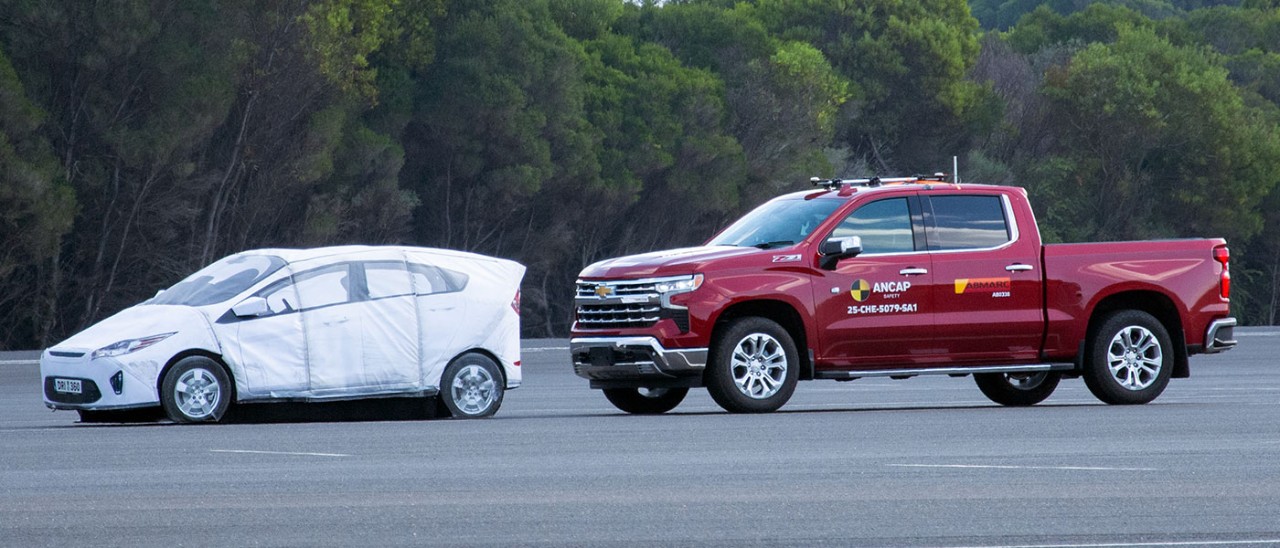
The pick-ups were tested in 48 different scenarios at the Australian Automotive Research Centre (AARC) in Victoria, studying whether they could avoid collisions in common scenarios like:
- a car at an intersection
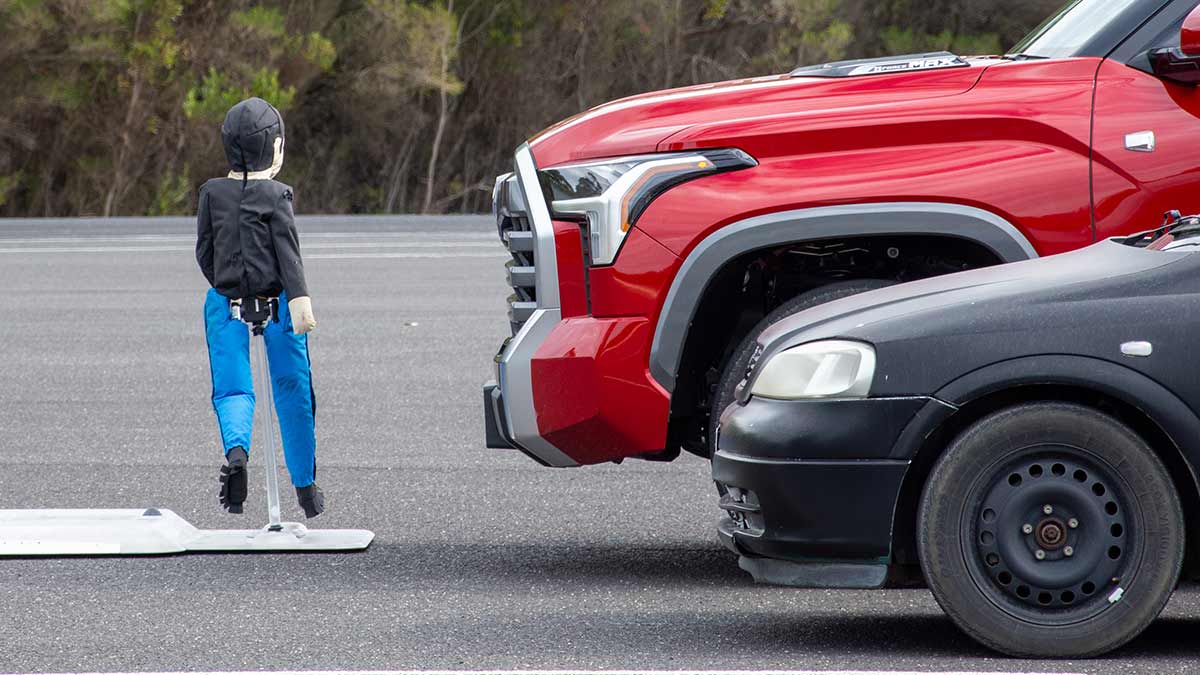
- a pedestrian crossing the road
- a child behind the vehicle when reversing
- a car in front when approaching from behind
- a cyclist
- an oncoming motorcyclist
Each scenario received an individual performance score, which was tallied to produce a percentage result under ANCAP’s Vulnerable Road User Protection and Safety Assist protocols. The overall grading was set by the lower of the two individual scores.
Physical crash testing was not conducted to measure occupant protection in each vehicle – hence no overall ANCAP star rating – but may be implemented in future. Driver vision assessments are also under consideration for the next round of testing.
“Larger vehicles pose a bigger threat to other road users than passenger cars,” says ANCAP CEO Carla Hoorweg. “The best way to reduce the potential risk of fatalities and serious injuries from large vehicles is to make sure they do the best possible job at avoiding a crash.”
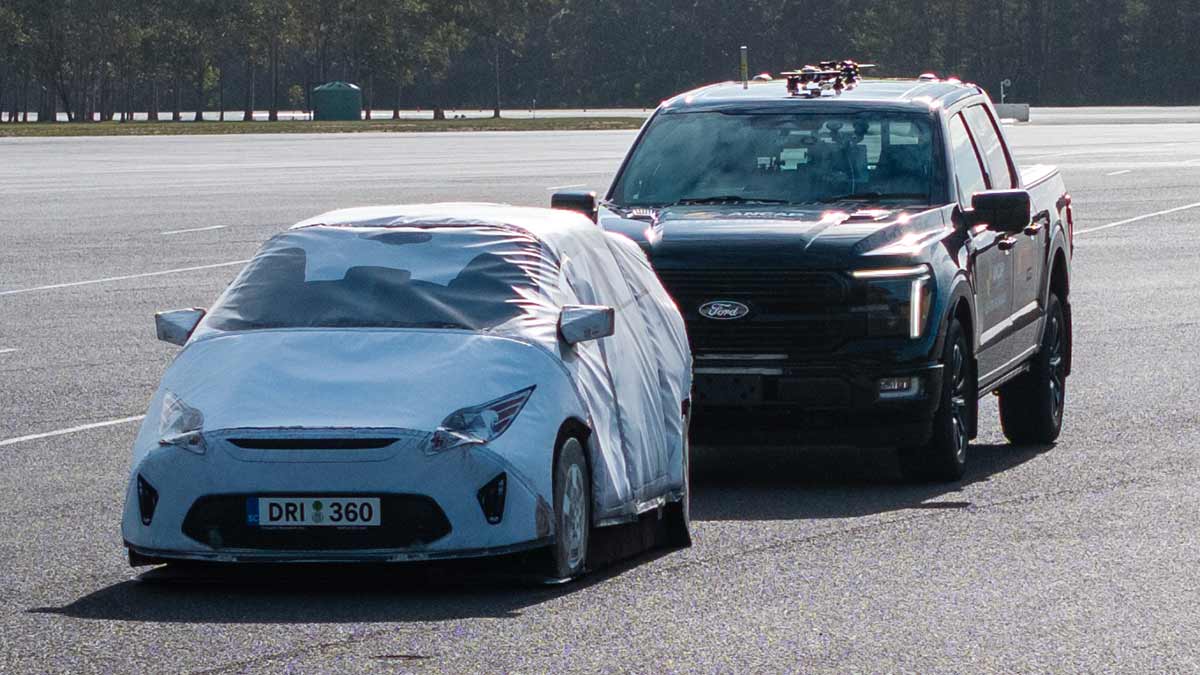
In car-to-car AEB tests, the Ford F-150 was able to avoid rear-end collisions with a stationary vehicle when approaching from behind.
The results
1. Ford F-150
- Overall result 81%
- Vulnerable road user protection 82%
- Safety assist 81%
The Ford F-150 delivered the best overall package of active safety features and reliable collision avoidance performance. The rating applies to F-150 Platinum and Lariat variants (from MY24).
Key findings:
- In car-to-car AEB tests, the F-150 had the highest level of performance of all models tested.
- When interacting with pedestrians, the F-150 avoided collisions in all scenarios where an adult pedestrian crossed or walked along the path of the ute, including when it was turning.
- Mild limitations were noted in the F-150’s ability to prevent collisions with a child pedestrian walking out from behind an obstruction (eg. parked car).
- Excellent results were observed for car-to-cyclist AEB performance.
- The F-150’s ability to detect and avoid or reduce the severity of a collision with a motorcyclist was also above other models tested.
- The F-150 was the only vehicle tested with an advanced system for reducing fatigue or distraction-related crashes, monitoring steering torque applied by the driver, activating various warnings (including brake pulse) and slowing the vehicle down if required.
The Ram 1500 handled complex intersection scenarios better than most of its rivals.
2. Ram 1500
- Overall result 70%
- Vulnerable road user protection 74%
- Safety assist 70%
The Ram 1500 demonstrated high levels of active safety specification and performance compared to the Toyota LandCruiser 70 Series, Toyota Tundra and Chevrolet Silverado 1500. The rating applies to Ram 1500 Limited variants.
Key findings:
- In car-to-car AEB scenarios, the Ram 1500 avoided collisions across a wide range of speeds as well as complex intersection scenarios where most of its competitors proved less capable.
- In AEB car-to-pedestrian testing, full points were scored for test scenarios where the adult pedestrian was walking in front of, and in the same direction as, the Ram. In turning scenarios, all impacts were avoided.
- Some limitations were observed in child pedestrian tests, particularly at night, but overall results were stronger than other models tested.
- AEB car-to-cyclist performance was good. The Ram 1500 detected cyclists travelling in the same direction and crossing its path, intervening to avoid impacts in most scenarios.
- In car-to-motorcyclist tests, the Ram 1500 was able to avoid or mitigate impacts with stationary and braking motorcyclists in rear-end scenarios, yet poorer performance was seen when turning in front of or changing lanes into the path of an oncoming motorcyclist.
- The Ram was the only model on test fitted with pedestrian-detecting AEB backover, which is commendable, however the performance of the system was rated as weak.
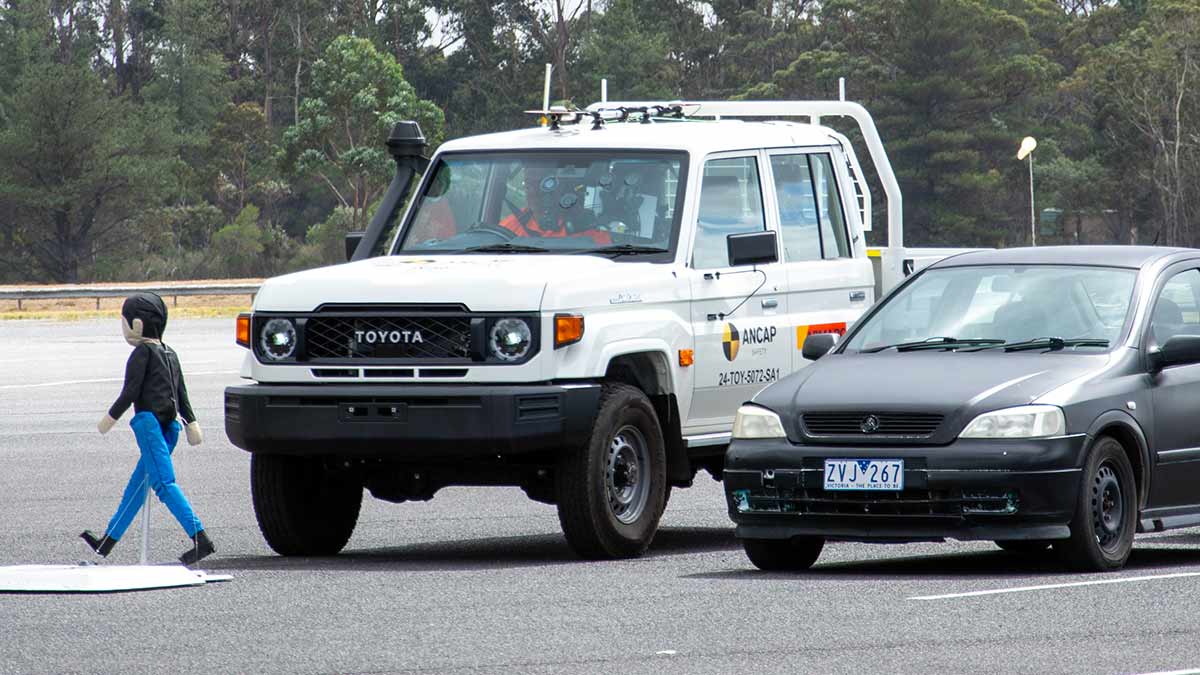
Car-to-pedestrian testing with the Toyota LandCruiser 70 Series delivered poorer results for child pedestrians compared to adults.
3. Toyota LandCruiser 70 Series
- Overall result 55%
- Vulnerable road user protection 56%
- Safety assist 55%
The Toyota LandCruiser 70 Series sits mid-field, missing out on ADAS such as reversing AEB, blind spot monitoring and any form of active lane keeping. However, where systems are provided, ANCAP says performance is generally robust. The rating applies to LC70 Single Cab and Double Cab 79 Series Ute variants.
Key findings:
- In car-to-car AEB tests, the LandCruiser 70 avoided most collisions at low and higher speeds but did not perform as well at intersections due to a narrower field of view for its camera sensor.
- Car-to-pedestrian AEB tests delivered solid results with adult pedestrians but weaker performance in child pedestrian tests, especially in darker conditions.
- Car-to-cyclist AEB performance was better when cyclists were travelling in the same direction as the LC70; the system was less effective when cyclists crossed in front or appeared from behind an obstructing vehicle.
- The LC70 ute is unable to brake or steer to avoid a motorcyclist when turning in front of an oncoming or overtaking rider.
- Without an active lane support system, the LC70 cannot actively prevent run-off-road, sideswipe or head-on crashes.
- The omission of common safety features such as lane support, seat belt reminders, blind spot monitoring and supplementary warnings limited the LandCruiser’s overall performance.
More: Research and compare Toyota LandCruiser 70 Series models on sale
Car-to-cyclist safety testing with the Toyota Tundra showed performance limitations when the bike rider was crossing in front.
4. Toyota Tundra
- Overall result 50%
- Vulnerable road user protection 56%
- Safety assist 50%
The Toyota Tundra has a broader set of safety features than the Toyota LandCruiser 70 Series – and the Chevrolet Silverado 1500 – however its performance sits close to the LC70. The rating applies to both the Tundra Limited and Platinum variants.
Key findings:
- In car-to-car AEB testing, Tundra avoided most rear-end collisions when approaching stationary, moving and braking vehicles but was less effective when turning across the path of an oncoming car.
- Car-to-pedestrian avoidance was good but weaker performance was seen when attempting to avoid a collision with a child pedestrian.
- Varied performance was seen in car-to-cyclist testing, the system performing well when cyclists were travelling in the same direction as Tundra but less so when the cyclist was crossing in front.
- When approaching a slowing (braking) motorcyclist, an impact occurred when the Tundra was following closely at a 12m distance.
- The Tundra’s AEB system does not function in turn-across-path intersection scenarios with an oncoming motorcyclist.
- Tundra’s lane support system can detect line markings and respond based on the vehicle’s position but does not consider the presence of a ‘threat’ vehicle in an adjacent lane.
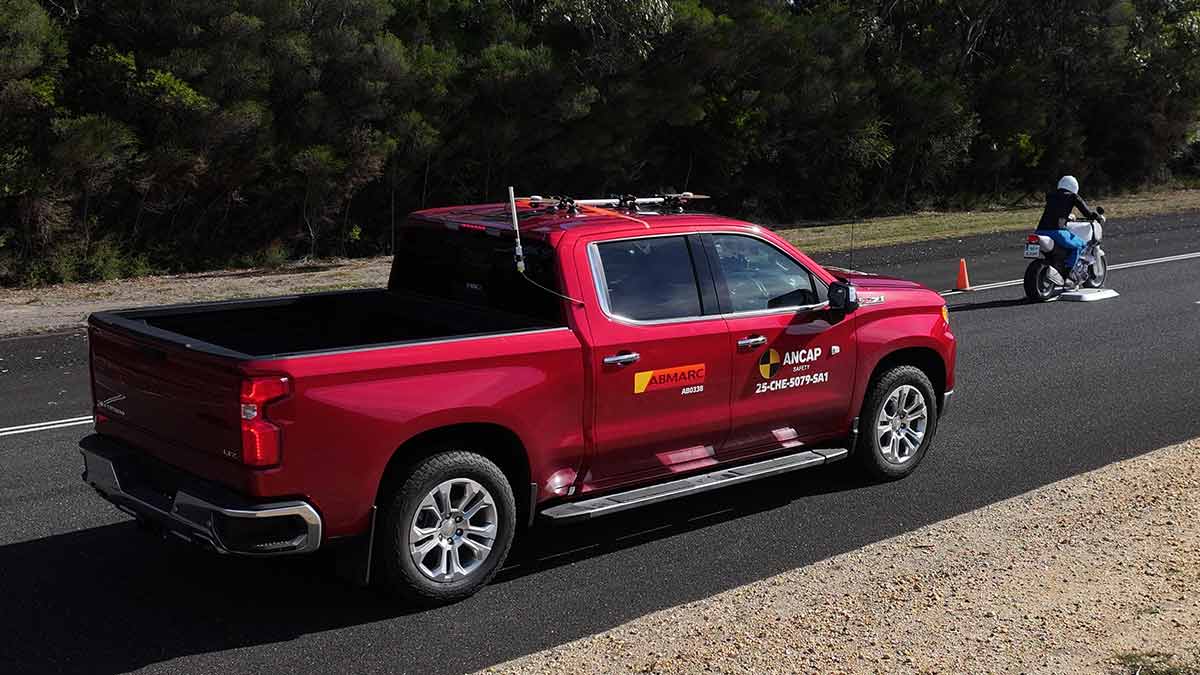
The Chevrolet Silverado performed poorly in test scenarios involving a motorcyclist.
5. Chevrolet Silverado 1500
- Overall result 27%
- Vulnerable road user protection 27%
- Safety assist 49%
Compared with the other large utes and US pick-ups tested, the Chevrolet Silverado lags in safety feature fitment and performance. For example, the Silverado relies on a camera-only AEB system (not radar) that can detect other vehicles and pedestrians, but not cyclists. The rating applies to both LTZ Premium and ZR2 variants.
Key findings:
- In car-to-car AEB testing, Silverado’s performance deteriorated when the speed difference between the test vehicle and target vehicle exceeded 50km/h. Intersection scenarios further highlighted the limitations of its camera-only system, with some crossing traffic not detected in time.
- In car-to-pedestrian testing (forwards travel), performance was good with adult pedestrians during daylight conditions but weaker at night or in sun glare.
- The Silverado delivered the best result of all vehicles tested in the child pedestrian ‘obstructed’ scenario.
- In scenarios involving a motorcyclist, performance was poor in complex intersection situations.
- As with Tundra, Silverado’s lane support system cannot detect the presence of another vehicle in an adjacent lane. Its emergency lane keeping system also did not meet performance criteria when deviating towards an unmarked road edge.
- A head-up display is fitted, earning recognition as a supplementary warning.
More: Research and compare Chevrolet Silverado 1500 models on sale
The information provided is general advice only. Before making any decisions please consider your own circumstances and the Product Disclosure Statement and Target Market Determinations. For copies, visit racv.com.au. As distributor, RACV Insurance Services Pty Ltd AFS Licence No. 230039 receives commission for each policy sold or renewed. Product(s) issued by Insurance Manufacturers of Australia Pty Ltd ABN 93 004 208 084 AFS Licence No. 227678.
/banners-and-thumbnails/Nissan-Qashqai-e-Power-ADAS-display-thumbnail-900x600.jpg.transform/imageMobile/image.jpg)
