Everything Australians need to know about EV insurance in Victoria, including how much it costs, what’s typically covered, and how insuring an electric vehicle compares with petrol and diesel cars.
Electric
The rules – and etiquette – of public EV charging
Learn the public EV charging rules in Victoria, including when you can use EV charging bays, how to avoid idle fees, and why good charging etiquette means moving your EV once it’s charged.
The popularity of electric vehicles in Australia continues to rise, with 103,700 battery electric vehicles (BEVs) sold in the country during the six months to June 2026 (equating to a 16.4 per cent market share). For the June 2026 period alone, BEVs accounted for 23.3 per cent of all new vehicle sales – up from 7.6 per cent for the same period in 2025.
As EV adoption grows, so too does the need for public EV charging facilities. But while most motorists are familiar with how a fuel bowser works, they might not be as confident with a public EV charger. And it’s not just EV drivers who need to understand the rules – petrol and diesel drivers do too.
In this article you'll find the laws concerning public EV charging in Victoria, as well as best practices and ways you can help be courteous when using public EV chargers.
RACV Members can locate nearby EV charging stations via the RACV App.
EV charging: Rules and etiquette
What are the different types of public EV chargers?
There are three main types of EV chargers in Australia: Level 1 (AC), Level 2 (AC) and Level 3 (DC). Of these, Level 2 and Level 3 are the types most often used in public charging locations.
Level 2 (AC) chargers are more likely to be found in locations where you might expect an EV to be parked for a period of several hours or more, such as at a hotel, workplace or resort.
Level 3 (DC) chargers are the fastest charging option available and are also known as 'ultra-rapid' or 'ultra-fast' chargers. Some newer EVs can charge from around 10 to 80 per cent in as little as 15-20 minutes, although charging times vary significantly depending on the vehicle charger.
These rapid charging points are commonly located where charging speed is of the essence, such as at service stations or dedicated bays close to major roads.
Public chargers will also specify the type of plug they use for charging. AC charging usually uses a Type 2 (Mennekes) plug, while DC fast-charging uses CCS2 (Combined Charging System Combo 2) or the less-common CHAdeMO plug typically found in some older EVs (such as the Nissan Leaf).
Tesla runs its own charging network, but many newer Tesla vehicles in Australia use the same Type 2 and CCS2 plug standards as other EVs. Some Tesla Supercharger sites are also open to compatible non-Tesla EVs. You’ve find more information below in this section, Can other EVs use Tesla EV chargers?
Most EVs in Australia come with a socket that fits a Type 2 and CCS2 plug.
How fast do different public EV chargers work?
Charging speeds and times can vary by charger and vehicle, but as a general rule of thumb:
Ultra-rapid DC charging stations rated up to 350kW: ~400km per 15 minutes
Fast DC charging stations rated up to 50kW: ~60km per 15 minutes
Standard AC charging stations rated up to 25kW: ~30km per 15 minutes
RACV Members can save at participating Chargefox ultra-rapid RACV charging stations across Australia.
Find out more about how to charge your electric vehicle in Victoria.
Not all public charging locations supply a charging cable, so it's best to carry your own just in case.
What are the actual rules for EV charging bays?
As outlined in the Victorian Road Safety Road Rules, only motorists using an electric vehicle may stop in a parking area designated for electric vehicles.
Furthermore, motorists can only stop in a parking area designated for the charging of electric vehicles if they are both:
- driving an electric vehicle; and
- the electric vehicle is plugged into an external electricity source (i.e. is charging)
What is the difference between an EV parking bay and an EV charging bay?
EV parking bays are spaces reserved or prioritised for electric vehicles, but they may not necessarily have a charger. They’re often provided to encourage EV use, support access for EV drivers, or allocate spaces close to charging infrastructure.
EV charging bays or areas are for the charging of electric-powered vehicles while they are parked. You must be charging your EV or hybrid vehicle while using an EV charging bay.
How do I know if a parking spot is for EV parking or charging?
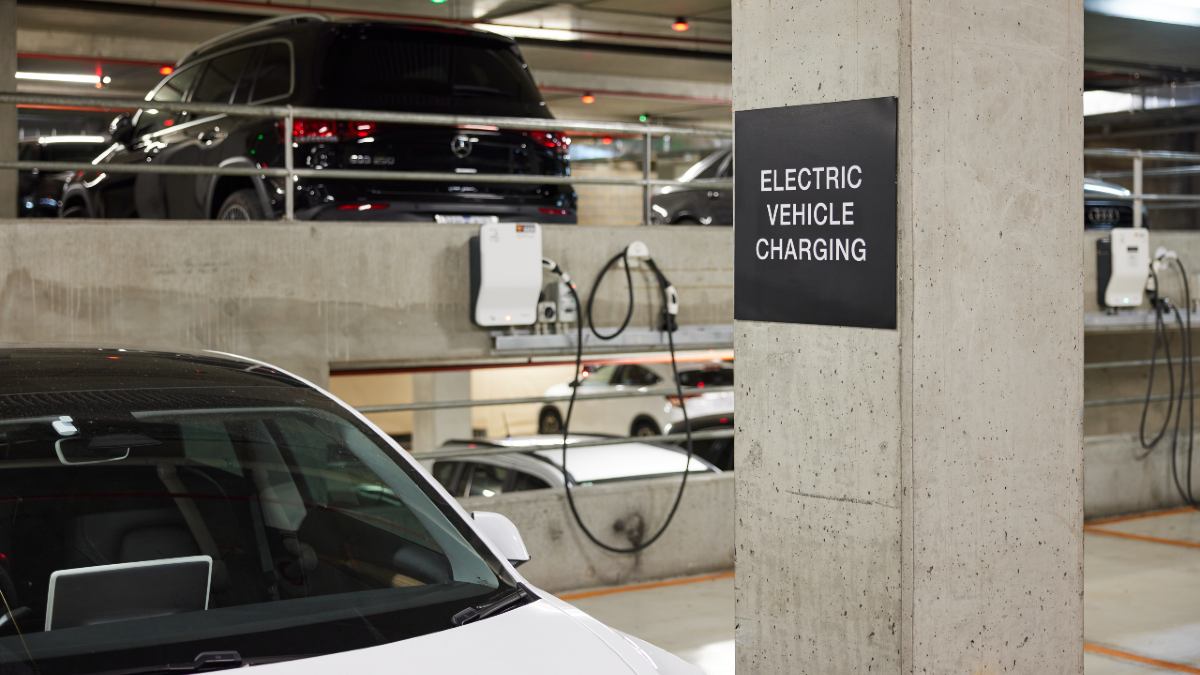
Parking or charging areas for electric vehicles are usually marked with signs, road markings, text or symbols. These markings should indicate whether the space is for EV parking or for EV charging.
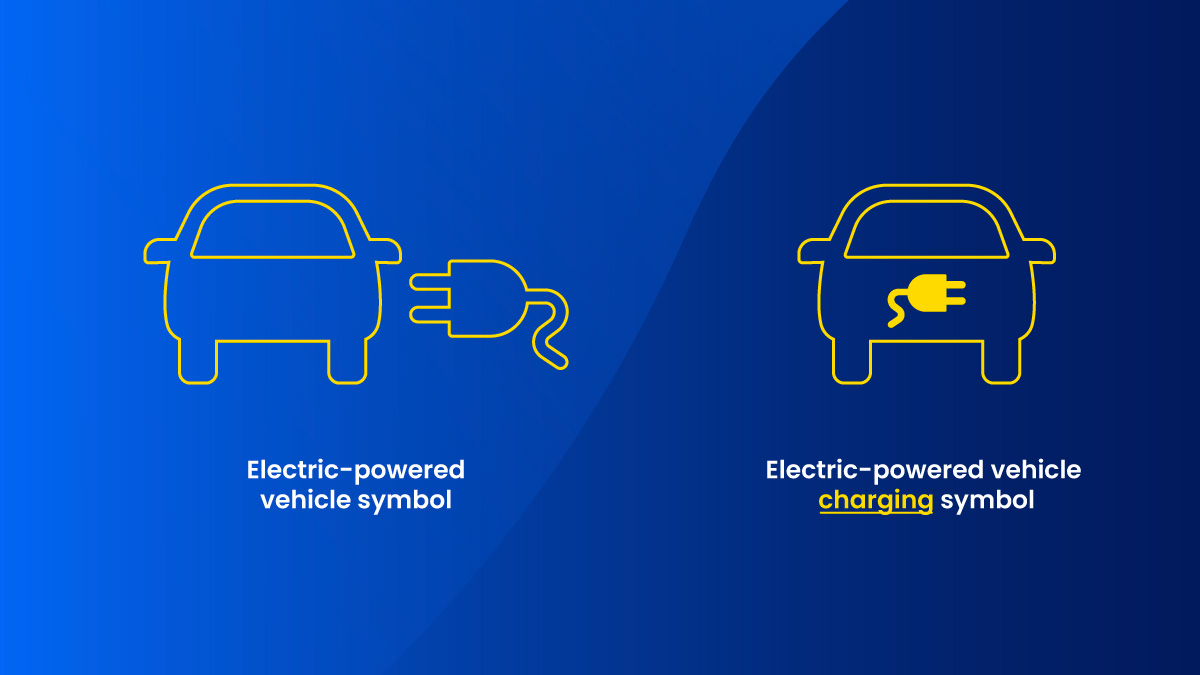
There are separate (but similar) symbols that indicate whether an area is for EV parking or EV charging:
- EV parking area: a car with a power plug beside it.
- EV charging area: a car with a power plug inside it.
Refer to the below illustration to see the difference between EV parking and EV charging symbols.
Left to right: A symbol indicating an EV parking area and a symbol indicating an EV charging area.
Can you be fined for parking in an EV charging bay?
Yes. In Victoria, motorists can be fined for parking in an EV charging bay if they are not driving an electric vehicle, or if the electric vehicle is not plugged in and charging. The penalty is two penalty units, which equals $418.20 for the 2026–2027 financial year.
Can I park a hybrid car in an EV charging spot?
The Victorian Road Safety Road Rules defines an electric vehicle as one that can be recharged from an external source and is powered by one or more electric motors regardless of whether it is also powered by another form of propulsion.
This means that some hybrid vehicles, such as plug-in hybrids, can use EV parking spaces or EV charging spaces if recharging.
Should you move your EV once it has finished charging?
The Australian Government recommends that EV drivers move their vehicle from the charging bay once you've finished charging.
You can help achieve this by understanding how long it will take to charge your vehicle based on your vehicle and the charger on offer. Many public charging stations have an app that helps you monitor charge status of your vehicle.
Using public chargers for more time than necessary may also incur extra costs from the operators. These are called 'idle fees'. Idle fees are not imposed at all public charging sites - check for signage indicating if idle fees apply before connecting your vehicle.
Can I park my EV in a charging bay if I'm not charging it?
No, it is illegal to park an electric vehicle in a parking spot designed for charging if you are not charging your vehicle. You can be fined for this.
What is ICEing?
ICEing or being ICEd colloquially refers to a petrol or diesel vehicle parking in an EV charging bay, preventing electric vehicle drivers from using the charger.
The term comes from “internal combustion engine” — or ICE — which refers to petrol and diesel vehicles.
In Victoria, motorists can be fined for parking a petrol or diesel vehicle in an area designated for EV parking or charging.
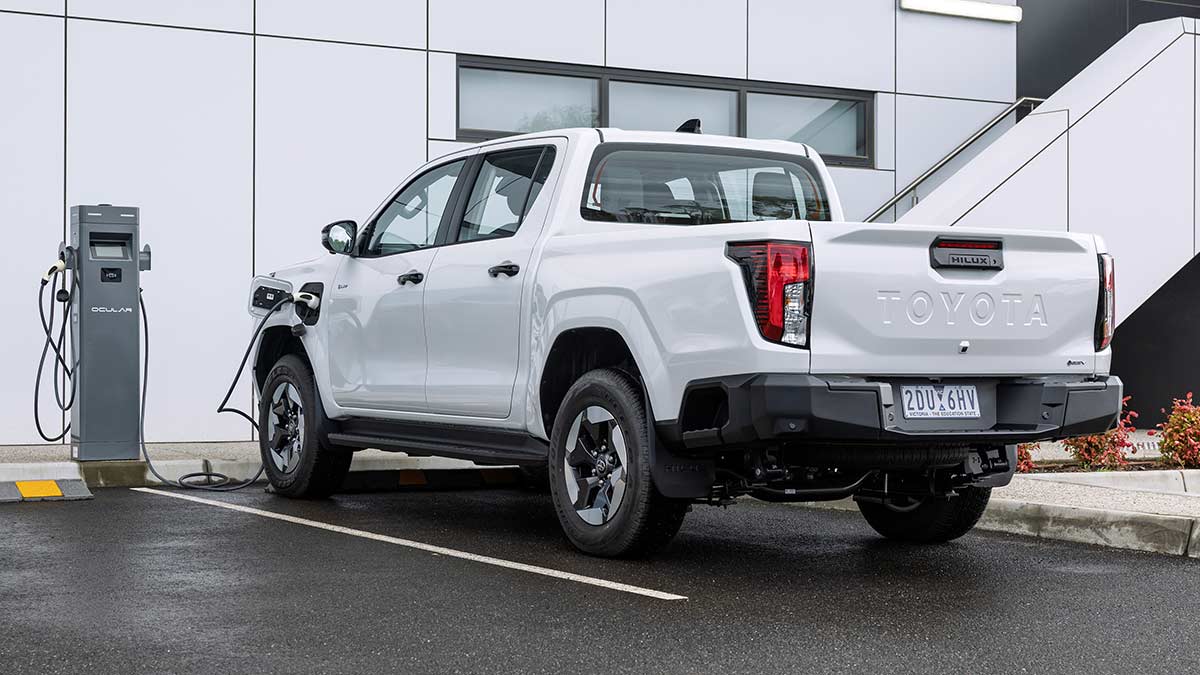
EV charging bays may be marked with text, symbols or both. Image: Matt Harvey
How long can I stay at a public EV charger?
The Australian Government advises that you move your vehicle from the EV charging bay as soon as you've finished charging it.
Know roughly how long it should take to charge your vehicle, and avoid leaving it in the bay for longer than needed.
Is it ok to charge to 100 per cent at public chargers?
As a courtesy to other EV drivers, it is recommended that you only charge your vehicle to 80 per cent when using a public charger (unless 100 per cent charge is absolutely required to reach your destination).
This is because vehicle charging can slow significantly when charging between 80 and 100 per cent battery capacity.
What to do if all EV chargers are occupied
Remember to be patient and wait your turn. Some vehicles can take longer to charge then others and many motorists are new to EVs and unfamiliar with public charging.
The Electric Vehicle Council reports that there are more than 1,200 public EV charging sites in Australia and tools such as the RACV App can also help you locate alternative EV charging sites should your first choice be fully occupied.
Is it okay to unplug another EV?
No, it is not okay to unplug another motorist’s EV. This applies even if their vehicle appears to have finished charging. Wait for the driver to return or use another charger if one is available.
EV owners need to download the Tesla app and have a Tesla account to use a Supercharger.
Can other EVs use Tesla EV chargers?
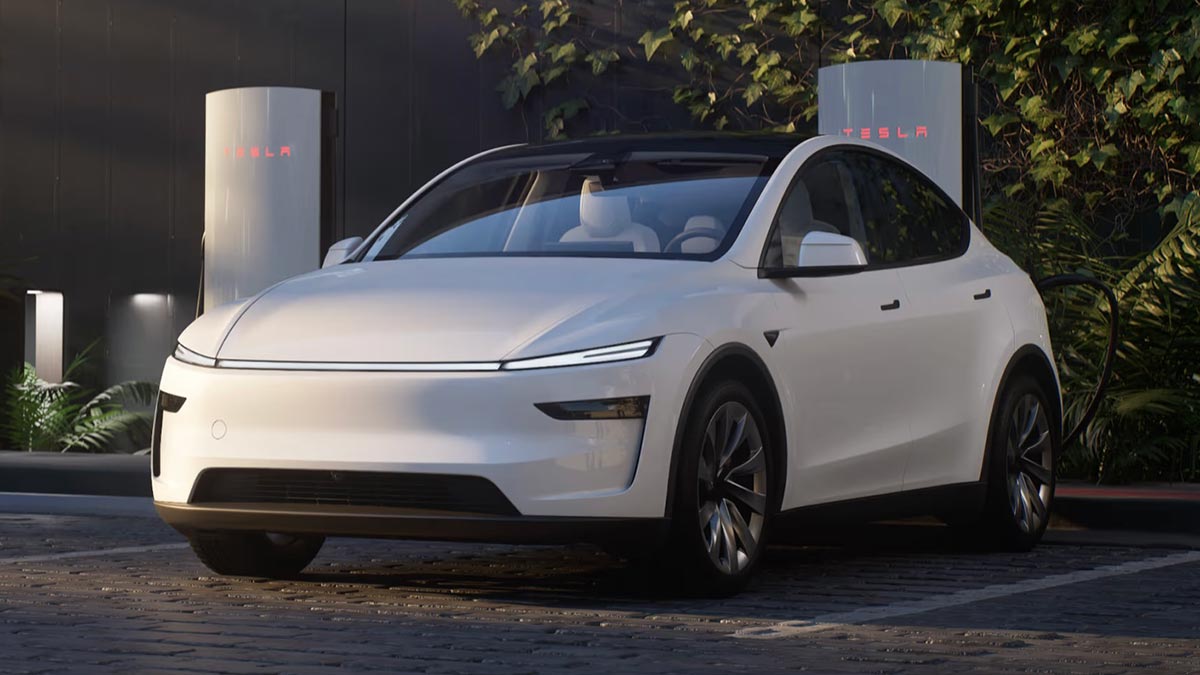
Yes, there are a number of Tesla chargers in Australia that can be used by any EV compatible with a CCS2 or Type 2 plug (which is most EVs sold in Australia). There are two types of Tesla-brand chargers you'll come across in public locations.
Tesla Superchargers
Tesla claims its Superchargers can charge up to 200 miles (321km) in 15 minutes, making them a convenient choice. They are a Level 3 charger that uses DC current to achieve ultra-rapid charging.
There are currently more than 25 Tesla Superchargers located in Victoria that are accessible to any EV with CCS2 plug compatibility, including 11 within metropolitan Melbourne. Note that not all Superchargers support non-Tesla EVs - you can locate your nearest Supercharger accessible to all EVs using the Tesla website.
You will also need to download the Tesla app and have a Tesla account to use a Supercharger, even if you don't have a Tesla vehicle.
Tesla Destination Chargers
Tesla Destination Chargers are a Level 2 charger that uses AC current to charge. This means they charge much slower than Superchargers, but are designed and installed at locations where it's expected you'll be staying for at least a few hours anyway (such as a hotel, workplace, shopping centre or restaurant).
These chargers can work with any EV that is compatible with a Type 2 (Mennekes) plug. However, operators of Tesla Destination Chargers can set them so that they will only accept Tesla vehicles. While the Tesla website can show you where Destination Chargers are located, they do not distinguish between chargers accessible to all EVs and those only accessible to Teslas. Whether or not a Destination Charger accepts non-Tesla vehicles may be flagged on PlugShare, a third-party EV charger locator website.
Most Destination Chargers don't require you to use the Tesla app or have a Tesla account.
Do non-Tesla EVs pay more to use a Tesla charger?
Yes, non-Tesla EVs can expect to pay more cents per kWH than Tesla vehicles when using a Tesla Supercharger. Prices vary by location and time of day, but non-Tesla EV drivers generally pay around 10 to 20 cents more per kWh than Tesla vehicles.
Alternatively, non-Tesla EV owners can purchase a Tesla Supercharging Membership which gives you access to the same charging prices as Tesla owners.
Destination Charger costs are set by the business or organisation that operates the charger and typically will cost the same to use regardless of EV brand. They may be free to use, or implement a kWh rate.
Can Tesla drivers use any public EV charger?
Yes, Tesla vehicles in Australia can use third-party public EV chargers that use Type 2 (Mennekes) or CCS2 connectors.
Older Teslas, such as the Tesla Model S sedan and Tesla Model X SUV sold from 2015-2020, may need an adaptor to work with current CCS2 chargers in the market.
Accessible EV charging bays should only be used if you,
- are charging an electric vehicle,
- are displaying a current accessible parking permit; and
- the person who holds the permit is currently travelling in the vehicle.
If you run out of charge while driving your EV pull over and park in a safe location. You can then contact your roadside assistance provider who will advise you of next steps (usually for your vehicle to be towed to a charging station).
Electric vehicles are included in all RACV Emergency Roadside Assistance plans at no extra cost. RACV is also currently trialling a mobile EV fast charger on one of its Melbourne-based patrol vans to recharge dead EV batteries on –the-go.
Broken public chargers should be reported to the operator of that specific charger. There may be contact information at the charging bay to do so, or you may be able to notify the operator through their charging app.
In addition to notifying the operator, you can help other EV drivers avoid using a broken charger by flagging it on EV charger networks maps.
No, in Victoria it is illegal for a petrol or diesel vehicle to park in an EV charging bay.
An idle fee is a charge applied for keeping your EV at a public charger for longer than necessary.
Not all charging sites impose idle fees. At sites where idle fees can be imposed, signage (or the charging site's relevant app) will usually notify you of this.
You can help avoid idle fees by reading and obeying all signage at the charging site, as well as by moving your EV as soon as you're done charging.
It is recommended EV drivers carry their own charging cable when using public EV chargers. Not all public chargers supply a cable - this is especially prevalent at AC charging sites.
RACV Trades is a trading name of RACV's trade partner, Club Home Response Pty Ltd (Victorian registered domestic building practitioner number CDB-U 100178). All works are performed or arranged by Club Home Response Pty Ltd. trading as RACV Trades. See RACV Trades terms and conditions.

