
Here are the cheapest and best affordable new hybrid and plug-in hybrid electric (PHEV) SUVs, hatchbacks, sedans, wagons and utes on sale in Australia in 2026 fof fuel savings.
Electric
Research and compare hybrid and PHEV cars on sale in Australia today
Research and compare family cars on sale in Australia today
Research and compare Denza cars on sale: models, specs, features, running costs and prices
BYD’s rise to the top in Australia: how it plans to overtake Toyota
BYD is set to become one of the top three car brands in Australia in 2026 and eventually plans to be market leader. Here’s the company’s outlook and strategy, from new EV and PHEV models to how it will better deal with customers.
Just four years after arriving in Australia, BYD has become one of the top-selling car brands with its fast-expanding EV and plug-in hybrid electric vehicle (PHEV) model range – and it does not plan to slow down until it has toppled Toyota for outright market leadership.
That would be a formidable achievement for the Chinese ‘Build Your Dreams’ brand that has turned a solid reputation for building EV batteries into the world’s biggest electric car brand (overtaking Tesla in 2025) and a top 10 global automaker.
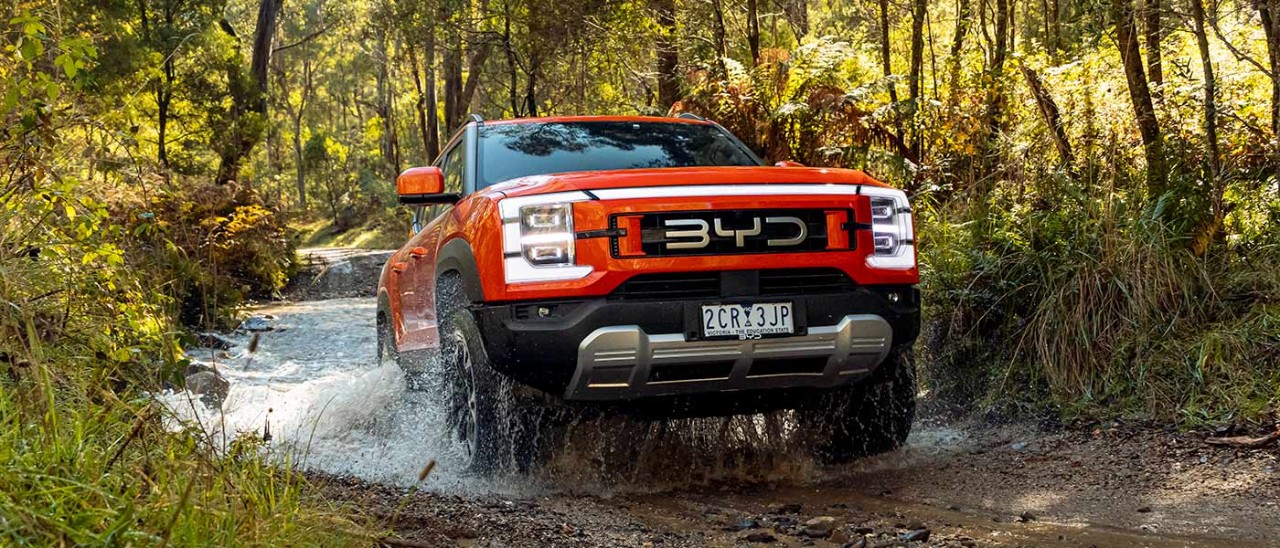
Although facing challenges overseas this year, BYD is going from strength to strength in Australia – now the number one market for the BYD Shark 6 ute worldwide. But how does it plan to maintain momentum and achieve its ambitious goals while meeting customer and owner expectations with its cars, dealer network, vehicle waiting times, parts and servicing, and complaint handling procedures?
In an interview with RACV, BYD Australia chief operating officer Stephen Collins details the brand’s forecasts, strategy and what it’s doing to ensure it doesn’t go from boom to bust.
More: Research and compare new cars, SUVs and utes on sale today in Australia
Does BYD plan to become the market leading brand in Australia?
Yes, BYD intends to overtake Toyota, which has been number one in Australia for the past 23 years and counting. Arriving in 2022 with a single model, the BYD Atto 3 SUV, the Chinese brand has now moved into the top 10 – achieving eighth position in 2025 with 52,415 sales and an eight-strong model range. It now expects to finish second or third in 2026 with close to 100,000 sales, led by the BYD Shark 6 ute (and the new Performance variant), Atto 2 small SUV, Sealion 7 medium SUV and Sealion 8 large family SUV. Outright leadership will take a little longer.
“We want to be a market leader. And you know what? Leadership is not for me just number one in sales – it’s a lot of things,” BYD Australia COO Stephen Collins tells RACV. “Toyota has been the market leader for a long, long time because they do a lot of things really well. So, yeah, I think that’s a goal – and it doesn’t matter whether it’s our parts department, our service department, our call centre; it doesn’t matter who it is, that’s what we want to do – to be the best at what we do. That makes you a leader.”
Research and compare hybrid and PHEV cars on sale in Australia today
How can BYD become number 1 when Toyota sells twice as many cars as any other brand?
BYD will continue to quickly expand its line-up (currently 11 model lines) and its dealer network and parts and service facilities. It has tapped into the growing desire among Australian buyers for cheap, economical and apparently good quality hybrid and electric cars and is now working to meet expectations in terms of waiting times and the broader ownership experience.
BYD sells the most affordable electric car on sale in Australia with the BYD Atto 1, and the cheapest electric SUV with the BYD Atto 2.
Collins: “The market is changing rapidly and I think a lot of it also gets down to how quickly you can adapt your business to the changes – the consumer changes, the macro changes of the world, the legislative changes – so I feel that our speed is second to none. We don’t do everything right, but we try and do things with speed, and I think that adding that speed with good quality really will put us into a strong position.”
Research and compare EVs on sale today: models, specs, features, running costs and prices
Is there a danger BYD’s rapid growth will create problems for buyers and owners?
Yes. BYD sales grew by more than 150% in 2025 and are on a similar trajectory in 2026, rising 110% to the end of April and set to increase further with unprecedented orders for its EVs – especially the BYD Atto 2 and Sealion 7 – amid the global fuel crisis. Collins is aware of the danger.
“Absolutely. We’ve got to do things well, we’ve got to do things for the long term, and we’ve got to do things to build trust,” he says. “None of this is new, but it’s just making sure that we match the speed with the quality and I think that’s what will set us apart.”
Collins admits BYD’s growth will inevitably taper off beyond strong ongoing growth predicted for 2026 and 2027 but isn’t sure how things will balance out in the medium term.
“It’s a good question,” he says. “It definitely can’t last forever but I honestly don’t know. It will depend a bit on the market. I think the commitment from us to continue to grow will be really, really strong but when it tapers, where we get to and where we sustain, I’m not sure. There’s so much uncertainty – there’s probably another 15 or 20 brands coming into this market; it’s going to make it 100 brands in a 1.2-million market (annual new car sales across the industry). And then there’s just all of the other uncertainties too.”
Research and compare family cars on sale in Australia today
How well is BYD treating its customers in Australia?
BYD has identified customer experience as its most important area for improvement as it continues to grow and launch new models in Australia.
“That’s the delivery experience, right through to service,” says Collins. “It’s not rocket science. We just need to keep improving in that area. For me, it (maintaining momentum) is doing what we’ve been doing but adding on top of that a better experience.”
Key areas of focus include:
- minimising vehicle delivery times
- minimising service booking times (down to a week or less)
- vehicle service and repair first-time fix (“and fix it well”)
BYD Australia has set up a local call centre operating from its Melbourne and Sydney offices, with 18 customer service reps who have a direct line of communication with Collins and other senior managers to relay to them “what’s hot, what’s not, what are we getting, what’s not working” for both the BYD and Denza brands.
“It’s all about direct access to the business – to fix problems, do things better, do things faster,” Collins says. “I think that’s pretty unique in the Australian automotive industry. What it brings is accountability, but it also brings authenticity.”
He adds: “Ultimately, we just want to keep building the momentum, building the trust, building the respect and ultimately not just sell a car once but have people come back and buy another one and a third one and a fourth one.”
Research and compare Denza cars on sale: models, specs, features, running costs and prices
How long do buyers have to wait for BYD cars to be delivered in Australia?
BYD says there are no issues with supply from the factory on any of its model lines, and no foreseeable issues with vehicle allocations for Australia. So waiting times, which vary according to individual orders, should be minimal.
The company has committed to delivering 30,000 vehicles in the third quarter of 2026, including a shipment of 5000 cars (mostly Atto 2 and Sealion 7 EVs) in early June, to fulfil existing customer orders and meet current demand.
“Supply is good, the capacity (at the factory) is good, the flexibility to switch between models is good,” says Collins. “So production is not a problem – if we can sell them, we’ll get the cars here and deliver them.”
More: BYD’s Denza brand in Australia: what makes it different?
What new BYD models are coming to Australia?
BYD currently has 11 model lines, recently adding the Seal 6 PHEV medium sedan and wagon and bolstering Shark 6 with Performance and Cab-Chassis variants. Collins says he’s happy with the brand’s market coverage but will continue to enter new segments where it can achieve good sales volume.
Here are key new BYD models under consideration – some locked in, others on the wish list and those not currently on the radar (with comments from Collins included):
- BYD Shark 6-based 4x4 off-road SUV – “more Denza territory but, yes, not off the cards”
- BYD Atto 5 medium electric SUV – “not off the agenda”
- BYD Atto 3 Evo small-medium electric SUV (upgrade) – “again, not off the agenda”
- BYD Sealion 8 EV (large SUV currently PHEV only) – “I think there is a market for it”
- BYD sports cars – “nothing on the horizon, but I would never say never”
- BYD Shark 6 EV ute (currently PHEV) – “possible”
- Full-size BYD pick-up truck – “not currently on the radar”
- Full-size BYD upper-large SUV (Toyota LandCruiser rival) – “not currently, no”
- BYD Seal 7 PHEV large sedan – Australian homologation approved
- People-mover (BYD M9 PHEV) – “yes”
“We’re not obsessed by being in every single segment but there’s still some segments, like people-movers, that we want to be in,” says Collins. He also sees “massive opportunities” to expand with new variants of existing models, from higher performance to more affordable cars pitched at fleet buyers.
More: 2026 BYD Shark 6 Performance & Cab-Chassis: price, specs and release date in Australia
How long will PHEV remain relevant in Australia?
“I don’t have a timeframe, but I think it’ll be pretty substantial,” says Collins, adding that it could depend on how Australia’s New Vehicle Efficiency Standard (NVES) evolves. “I think right now, and in the foreseeable future, PHEV is a really good solution for people who don’t want to go full EV.”
More: 2026 BYD Seal 6 sedan & Touring wagon: price, specs and release date in Australia
Will EVs still be popular after the fuel crisis spike?
Demand for new EVs and PHEVs have skyrocketed in Australia in 2026 in response to the current fuel crisis, accounting for 20% (combined) of all new vehicle sales to the end of April – up from 13% in 2025.
EV searches on RACV Car Match increased by 461 per cent in March, compared to the month prior, with brands BYD, MG and Chery among the most searched for the month.
“It’s continuing to grow. Regardless of the spike that we’ve seen because of the oil crisis, it’s still strong growth and I think that’s absolutely going to continue – no question,” says Collins.
What is it about BYD that’s resonating so strongly with Australian buyers?
- Models offered
- Dealer network coverage
- Servicing and repairs, parts availability
“When I look at it simply, product is one thing – I think our product is stronger, our brand is stronger, for a whole host of reasons,” says Collins. “That’s one part of it. The other part is our dealers and our dealer partners, the speed with which we’ve built the network – and we’re still building the network.”
BYD relies heavily on a few major dealer groups to manage sales, servicing and parts supply across Australia, with the network now at 100 dealerships and set to reach 150 during the third quarter of 2026. Collins believes this could expand to as many as 200 outlets, spreading into new regional and remote areas and almost all of them as full-service operations. In metro areas, count on a prominent street presence, too.
“If you turn up to a strip of dealerships and you’ve got a number of small brands tacked on the end, but you’ve got big presence of a BYD dealership, I think it just shows commitment to the market and it builds that familiarity,” Collins says. “It says a lot about the brand.”
A national service centre opened in mid-2025 to train technicians and other dealer staff. The company has also invested heavily in parts warehouses in Melbourne, Sydney, Brisbane and Perth to reduce delays in servicing and repairs. These centres are designed to hold 99% of the most sought-after (fast-moving) parts and are currently able to deliver the required parts for any repair in 94% of cases (its target is 95%).
More: The best new car warranties in Australia
What other factors are behind BYD’s popularity?
- Value for money
- Technology
- Value pricing, no discounting
- Local R&D – safety systems, Crawl mode, suspension tuning
- Ultra-rapid Flash charging network
According to Collins, other factors behind BYD’s popularity include its cars’ value for money, technology and consistent pricing – holding its retail pricing firm rather than frequent discounting. This, in turn, is improving resale value, although there’s more work to be done here.
“Our strategy is price appropriately (at launch) and price aggressively where we need to – and then not touch the price,” he says. “Certainly, for the last year or even more, we have not touched the price. Like everyone, we do campaigns, but it’s just so important for residuals (resale value) and trust, not to be dropping the price of the car by five grand two months after you launch it. We want to maintain our price integrity.”
Collins also points to local R&D – Australia now leads global development for BYD Shark 6, for example, and has 15 local engineers working on range-wide suspension tuning and software updates including the new Crawl off-road mode on Shark 6 and driver assist safety system calibration.
Furthermore, BYD Australia is committed to building its own local ‘Flash’ charging network that can supply extreme power outputs (up to 1500kW) and replenish the latest BYD (and Denza) EV batteries from 10 to 97 per cent in a claimed nine minutes.
What does ‘long-term commitment’ mean from BYD’s point of view?
- Ongoing investment
- Timely spare parts supply as an example
“I don’t think there’s ever been a conversation about putting a timeframe on it,” says Collins. “What it is (that’s crucial) is the investment that’s happening at the moment – and I always use the parts example. We have got a 15,000-square-metre shed in Melbourne holding $20 million worth of parts, plus three others (Brisbane, Sydney and, from June 1, Perth), so … the level of investment is here for the long, long term to be successful.
“This is an advanced market, relatively small on a global scale, but the company is here for the long term, without question.”
More: Electric vehicles in Australia: Complete buyer and ownership guide
The information provided is general advice only. Before making any decisions please consider your own circumstances and the Product Disclosure Statement and Target Market Determinations. For copies, visit racv.com.au. As distributor, RACV Insurance Services Pty Ltd AFS Licence No. 230039 receives commission for each policy sold or renewed. Product(s) issued by Insurance Manufacturers of Australia Pty Ltd ABN 93 004 208 084 AFS Licence No. 227678.

