We've recently reviewed and updated our Privacy Charter, which describes how we use cookies and other technologies to understand and improve your browsing experience. By using our site, you agree to us collecting this information and to our Privacy Charter.
You’ll be sent the latest news, exclusive offers and competitions to your inbox.
Review
2026 BYD Shark 6 Dynamic Cab Chassis review
Terry Martin
June 02, 2026
The BYD Shark 6 Dynamic Cab Chassis opens up new options for customising the back end of BYD’s popular plug-in hybrid dual-cab ute, but it does have its drawbacks.
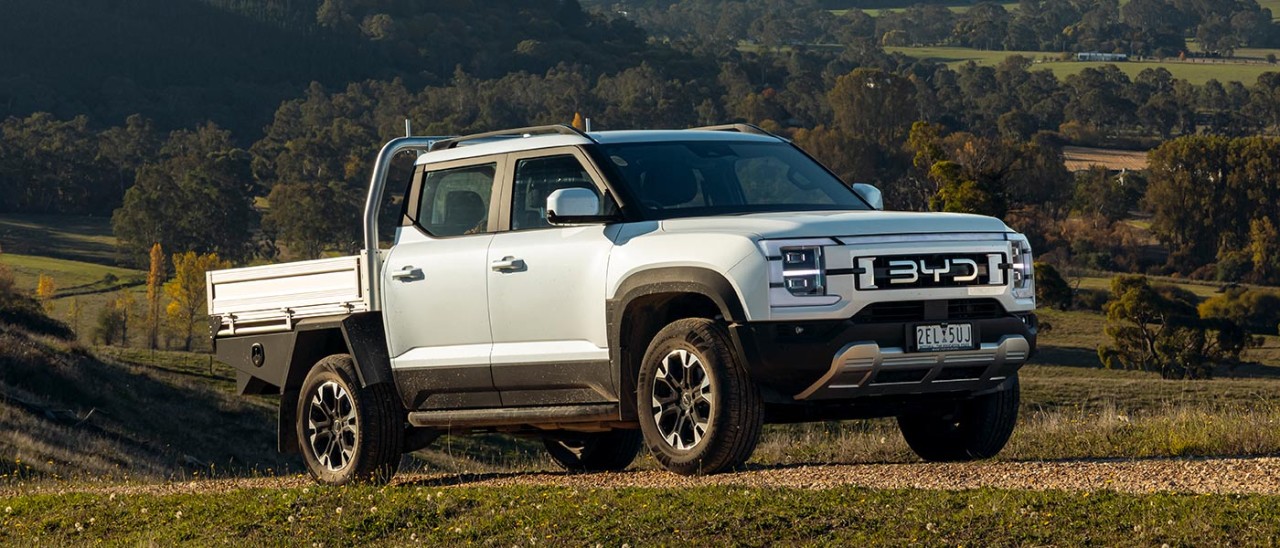
The new 2026 BYD Shark 6 Dynamic Cab Chassis is a unique offering in the Australian market as the first to combine a plug-in hybrid powertrain and the regular dual cab without a factory-fitted rear tub.
Instead, the open chassis at the back end allows Shark 6 buyers, especially tradies and 4x4 enthusiasts, to custom-fit a tray or service body to suit their specific requirements – or, as BYD is hoping, to order the Ironman alloy tray developed for the ute.
This gives the BYD Shark 6 an advantage over plug-in hybrid ute competitors including the Ford Ranger PHEV and the GWM Cannon Alpha PHEV, neither of which offer a cab chassis variant. But the BYD Shark 6 Dynamic Cab Chassis does have its limitations.
You’ll need to add into the equation the cost and fitment of a tray – either the factory-approved heavy-duty Ironman alloy tray that can be ordered at the dealership or online using BYD’s configurator, or your own (approved) configuration which must be fitted at the dealer. This quickly pushes up the price as the Ironman tray costs $5000 and requires an extra $1155 for fitment. (The tray with a trundle draw is $7959 fitted.)
As a result, the drive-away price for Victorian private buyers is $65,877.45 without other options – about $4300 more than the Premium – so the advantages brought with the Cab Chassis rear end need to be palpable to go in that direction, especially when it loses some key equipment in Dynamic trim compared to Premium.
What does it miss out on? Key omissions in the Shark 6 Dynamic compared to the Premium grade include a head-up display, driver’s seat lumbar adjustment, heated and ventilated front seats, leather steering wheel trim (fake leather is used), the bigger 15.6-inch touchscreen (this one’s down to 12.8-inch) and Continental tyres (it makes do with Giti tyres).
What’s more, the Cab Chassis also has a lower payload than the regular pick-up once the Ironman tray is fitted (see our section on weights and towing below).
In other respects, the features level remains attractive at this price point. On the tech front, for example, there’s still a 10.25-inch digital instrument cluster, wireless Apple CarPlay/Android Auto, DAB+ radio, voice assistant, native sat-nav, wireless phone charging, premium Dynaudio 11-speaker audio and remote cloud services.
That said, the two-year free data subscription (2GB per month) found further up the line isn’t offered on the Cab Chassis, and it also misses out on Google Automotive Services, which is embedded in the ute’s hardware and integrates with Google Maps, Google Assistant and Google Play Store.
The PHEV’s Vehicle to Load (V2L) capabilities for charging power tools and running camping gear etc are present, with the exterior 230V power points set neatly alongside the battery charging port in a lockable side storage box on the Ironman tray. It’s a pity the exposed fuel tank cap doesn’t have a lock, so we’d be replacing that ASAP.
BYD says the service intervals and capped price servicing costs remain the same for Cab Chassis as other Shark 6 variants at 12 months/20,000km and just under $500 per service (on average) for the first five years/100,000km (total: $2489). The vehicle and the Ironman tray are covered by BYD Australia’s six-year/150,000km factory warranty, while the high-voltage battery has a separate eight-year/160,000km warranty.
The BYD Shark 6 Dynamic Cab Chassis misses out on equipment found in the Premium pick-up.
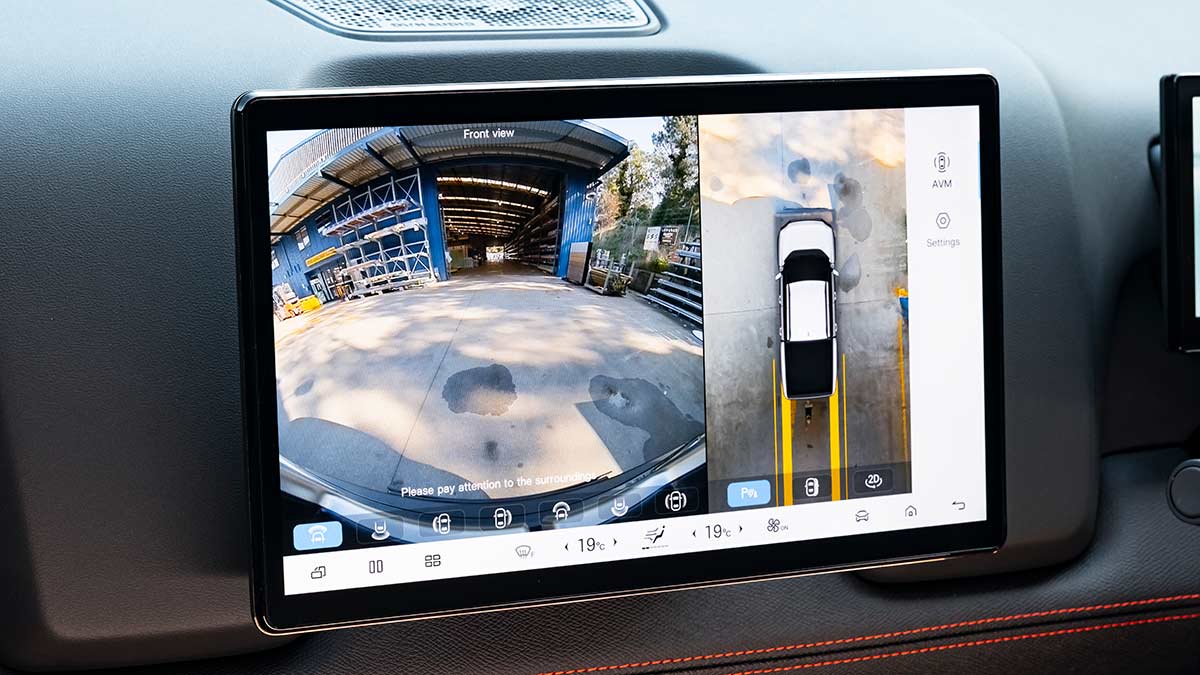
The BYD Shark 6 Cab Chassis touchscreen is a bit smaller, but still has high-res camera views.
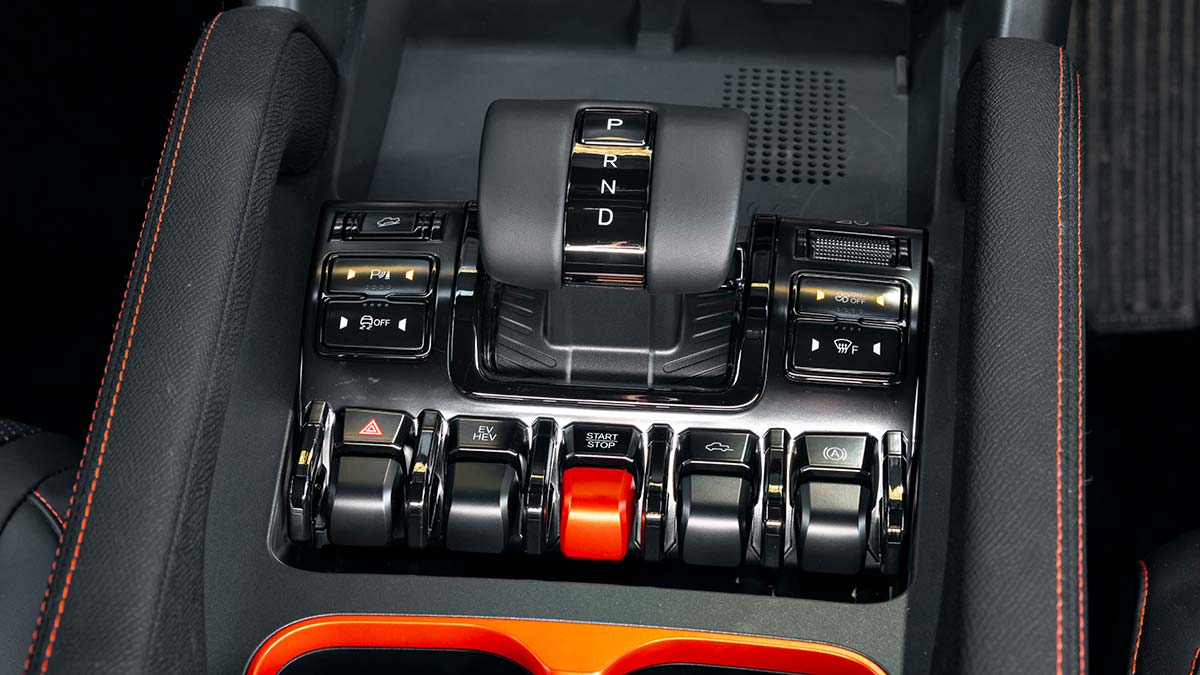
BYD Shark 6 Cab Chassis sticks with aircraft-style switchgear and gear lever on the centre console.
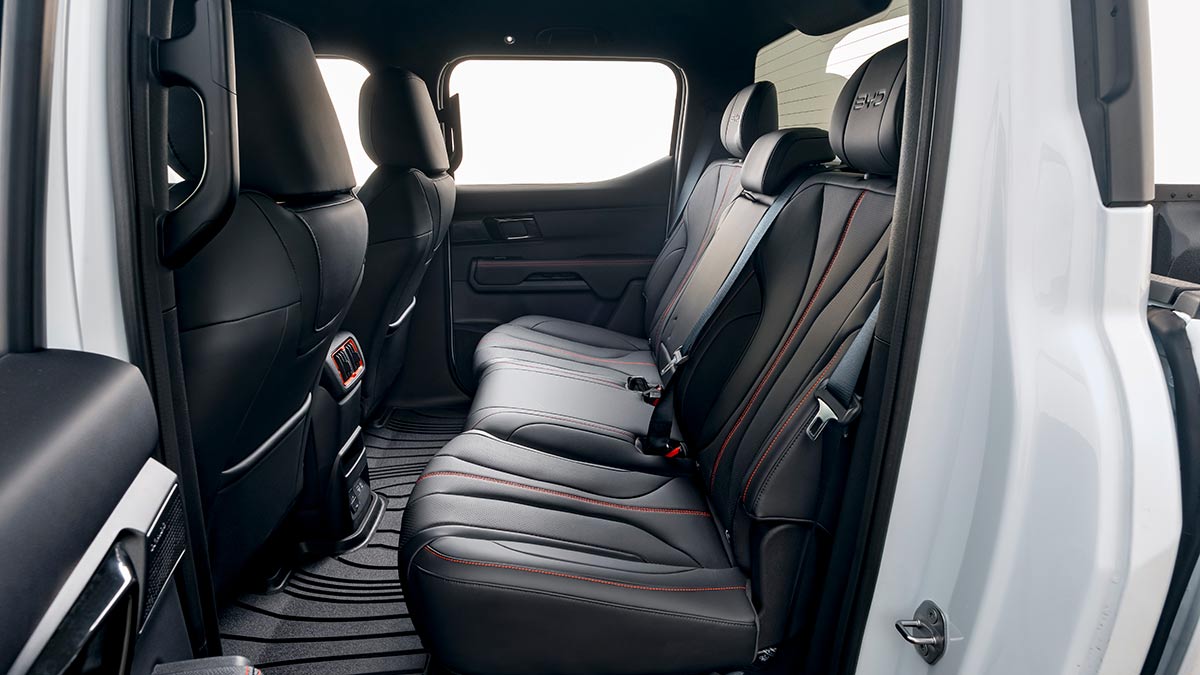
Rear seat space is generous in the BYD Shark 6 Dynamic Cab Chassis.
1 of 4
What is the BYD Shark 6 Dynamic Cab Chassis like inside?
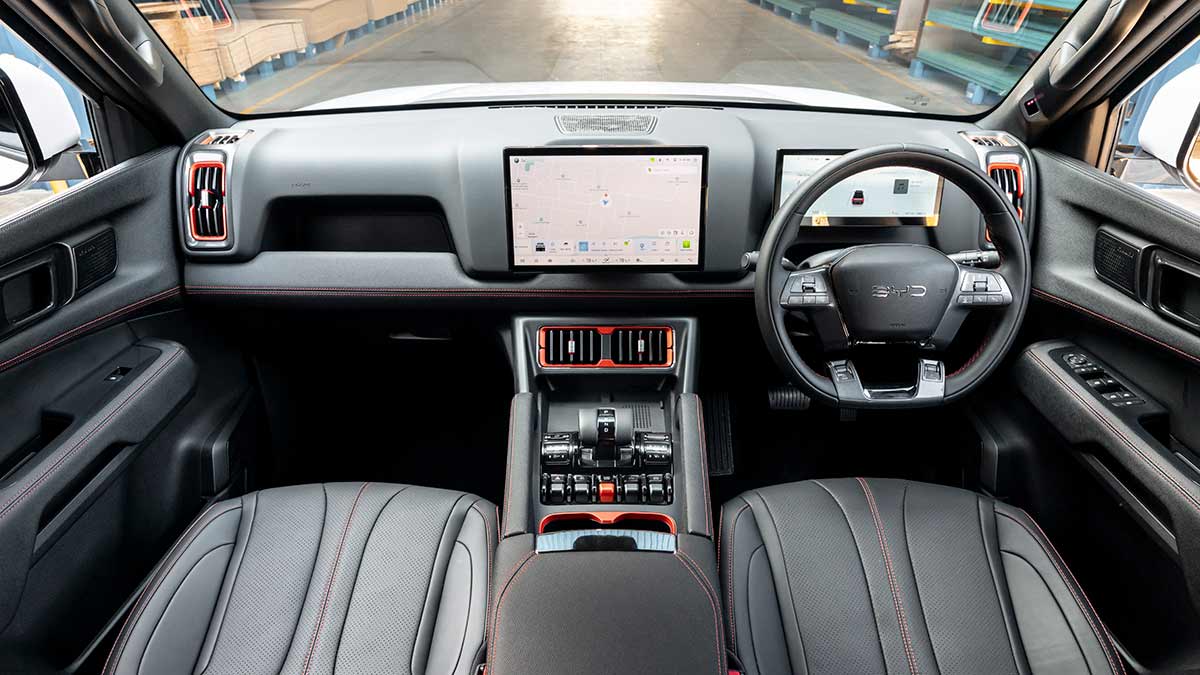
Notwithstanding the equipment deletions mentioned above, the 2026 BYD Shark 6 Dynamic Cab Chassis offers a spacious cabin for five occupants and feels good from behind the wheel. It still has a high-tech, high-spec feel for a workhorse ute and ticks a lot of boxes in terms of overall presentation, seat comfort and support, driving position and general ergonomics.
The smaller 12.8-inch central touchscreen doesn’t feel at all second-rate, with sharp graphics and camera views and excellent responsiveness to driver inputs when moving through screens – alas, something that’s often required to get to certain functions.
We suspect many buyers will also appreciate that the Shark 6 Cab Chassis hasn’t yet picked up the redesigned centre console and steering wheel found in the new BYD Shark 6 Performance flagship. That means it sticks with a transmission selector on the centre console (rather than the steering column), continues with tactile driving mode switchgear on the tiller, and features a raft of chunky aircraft-style controls on the lower dash for things like climate, hill descent control (HDC), start/stop, EV/HEV mode, tailgate release, park brake and hazard lights.
Across the rear seat there’s generous space in all directions and useful amenities such as air vents, device charging points (USB-A and USB-C), another 230V power socket, pull-down centre armrest (with cup holders) and small-item storage in the doors and behind the console and front seats.
The 2026 BYD Shark 6 Dynamic Cab Chassis has a maximum payload of 900kg without a tray fitted, based on the 3500kg gross vehicle mass (GVM) and 2600kg kerb weight. Given that it can’t be driven out of the dealership without a tray fitted, payload inevitably drops as accessories are added.
With the factory-approved 150kg Ironman tray, payload falls to 750kg – less than the Premium pick-up (790kg). As with any vehicle, other accessories will also eat into the carrying capacity – and if you’re towing at the limit (2500kg) you can wipe off another 250kg for the tow ball download weight, leaving just 500kg. Official dealer-fit BYD options on the table include a $4249 bull bar (ADR-compliant winch-ready triple-hoop design with recovery points). GVM upgrades are available, too.
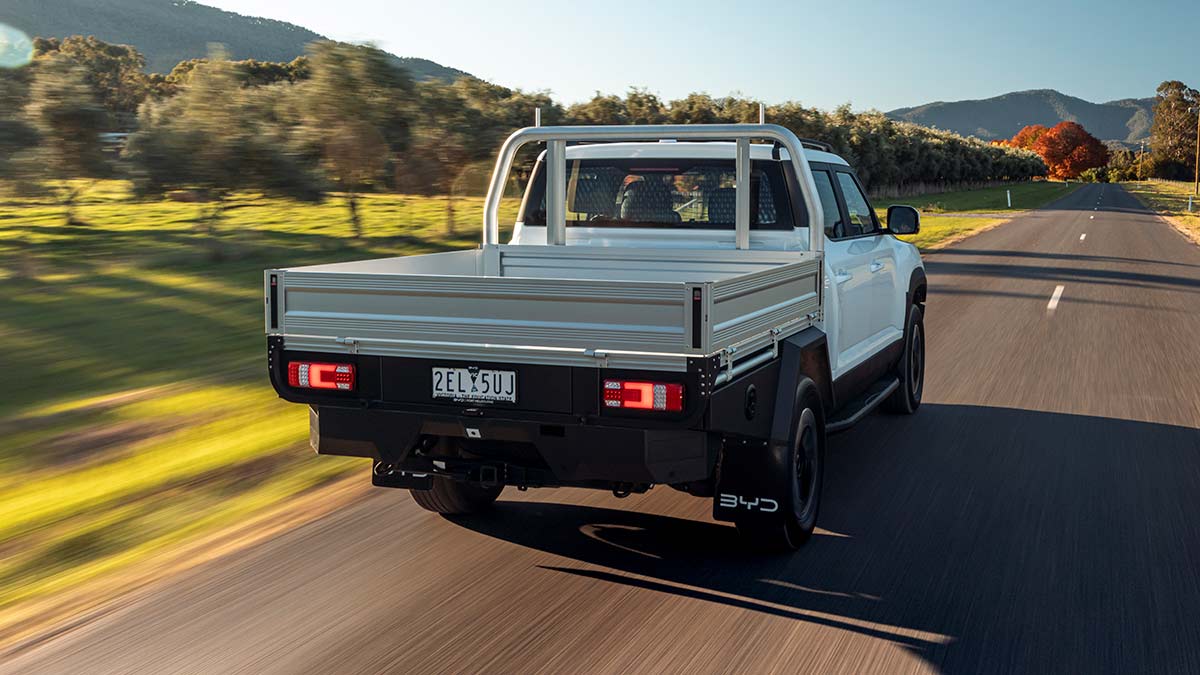
The Ironman tray was developed in Australia and measures 1679mm long, 1809mm wide and 259mm high. As an OEM-approved accessory, BYD has ensured full integration with the ute’s electrical and safety systems, plus a neat solution for the charging port and V2L sockets in one of the two lockable storage boxes. Eight integrated tie-down points are also included.
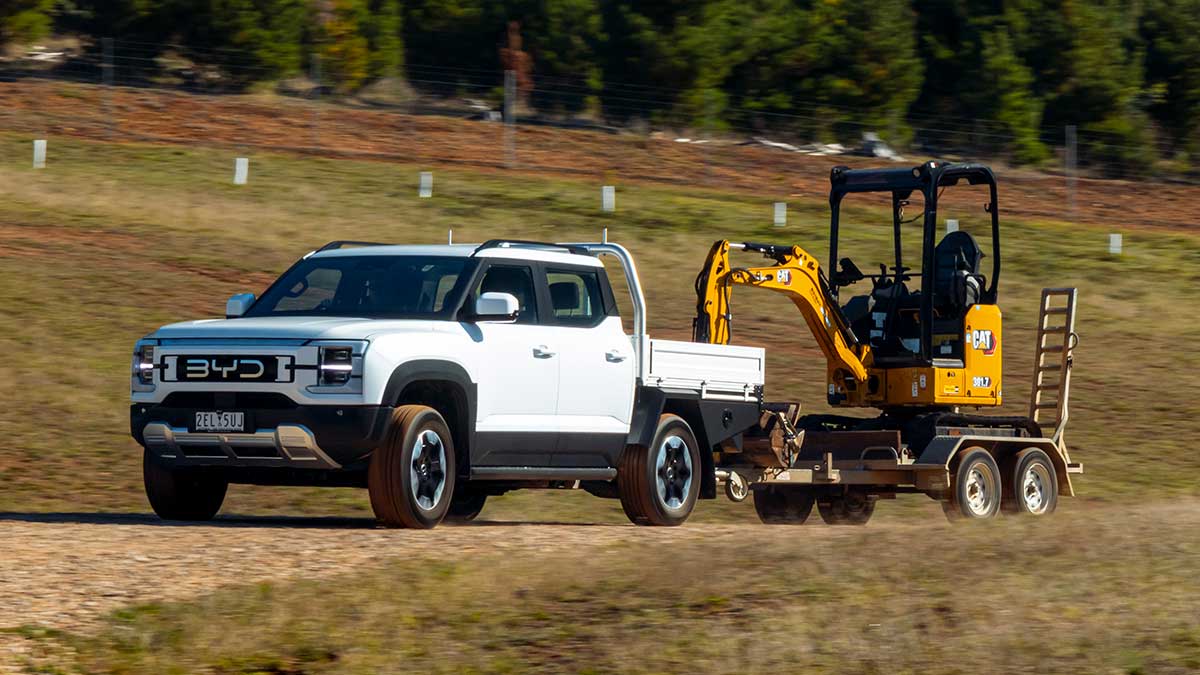
Based on the 1.5-litre plug-in hybrid system found in the Shark 6 Premium, the Dynamic Cab Chassis has a 2500kg maximum braked towing capacity. This is 1000kg down on the class benchmark, which the new Shark 6 Performance meets with its higher-output 2.0-litre PHEV system. If there’s enough demand, BYD says a 2.0-litre version of the Shark 6 Cab Chassis will be introduced.
The 2026 BYD Shark 6 Cab Chassis has a 2500kg towing capacity, but at this full limit, payload for the ute shown here is just 500kg.
The BYD Shark 6 Dynamic Cab Chassis has excellent refinement out on the open road.
1 of 2
Is the BYD Shark 6 Dynamic Cab Chassis good to drive?
The 1.5-litre plug-in hybrid system in the 2026 BYD Shark 6 Dynamic Cab Chassis combines two electric motors (one on each axle) with the relatively small turbocharged petrol engine for a total power/torque output of 321kW/650Nm.
That’s down on the new 2.0-litre Performance version (350kW/700Nm) but the Cab Chassis remains a solid, EV-oriented performer that’s relatively strong, very smooth and supremely quiet on the road.
With about 400kg in the tray on our launch drive, the Shark 6 CC – which sticks with fully independent suspension – managed the load onboard with ease and proved adept at ironing out most road imperfections and maintaining good composure in the process. On a closed road circuit, however, the standard 18-inch 265/65-series Giti tyres did not provide as much grip as the same-spec Continental tyres on the Shark 6 Performance (also fitted to Premium).
Average fuel consumption in mixed conditions came in at 7.3L/100km, but owners could expect a better return if the ute spends more time in the city, where EV running is prioritised.
As with its stablemates, the Shark 6 Cab Chassis is handy off-road but doesn’t have low range gearing, mechanical locking differentials and other components to maximise performance when the going gets really tough. It will pick up the newly developed Crawl mode introduced on the Shark 6 Performance via an over-the-air (OTA) software update later in 2026, but its effectiveness is limited.
As with all other variants of the BYD Shark 6, including the new Shark 6 Performance, the 2026 BYD Shark 6 Dynamic Cab Chassis qualifies for a maximum five-star ANCAP safety rating, based on testing conducted in 2025 with the Premium model.
The Cab Chassis does lose the head-up display found in pick-up models, but otherwise the key safety features carry over – from seven airbags through to a comprehensive suite of advanced driver assistance systems (ADAS).
Some of these, such as driver monitoring, can be irritating, and the Shark 6 doesn’t yet have an automatic collision notification and emergency call system, but BYD is continuing to work on ADAS calibration and is also beginning to roll out eCall in Australia, so expect ongoing additions and improvements in these areas.
2026 BYD Shark 6 Performance first drive | 🔎 RACV car reviews video
Should I buy the BYD Shark 6 Dynamic Cab Chassis?
The 2026 BYD Shark 6 Dynamic Cab Chassis is a welcome addition to BYD’s game-changing plug-in hybrid ute brigade, opening up new options for those who want to customise the back end. This does, however, bring with it compromises compared to the Shark 6 Premium pick-up – higher costs, less equipment and less payload, too, so it’s appeal will be limited to owners (and fleets) with specific needs.
We’re not ready to overlook proven diesel-powered one-tonner cab-chassis utes, led by the Ford Ranger. Among PHEV dual cabs, though, the Shark 6 Cab Chassis has no direct rival, and even with the equipment deletions it remains solid value. Just how well the Shark 6 CC stacks up for harder-core tradie and 4x4 work, we’ll have to wait and see, but we’d suggest it’s worth a look if the job at hand isn’t right on the limit.
The information provided is general advice only. Before making any decisions please consider your own circumstances and the Product Disclosure Statement and Target Market Determinations. For copies, visit racv.com.au. As distributor, RACV Insurance Services Pty Ltd AFS Licence No. 230039 receives commission for each policy sold or renewed. Product(s) issued by Insurance Manufacturers of Australia Pty Ltd ABN 93 004 208 084 AFS Licence No. 227678.
Want more articles like this?
Subscribe to RACV News for advice on cars, safety, home and travel.