We've recently reviewed and updated our Privacy Charter, which describes how we use cookies and other technologies to understand and improve your browsing experience. By using our site, you agree to us collecting this information and to our Privacy Charter.
You’ll be sent the latest news, exclusive offers and competitions to your inbox.
Review
2026 Toyota HiLux BEV review
Terry Martin
July 17, 2026
The Toyota HiLux EV is a bold new venture from Australia’s market-leading auto brand, but can its green credentials outweigh the drawbacks inherent in this all-electric dual-cab ute?
Did you ever think you’d see the day when the Toyota HiLux was an EV?
Well, you’d better believe it, because the 2026 Toyota HiLux BEV is now on sale, humming its way into Aussie hearts and minds with two electric motors and a high-voltage battery that will get you from A to B – hopefully – in smooth and quiet fashion that’s nothing like a diesel.
Testing was conducted in Australia over more than two years with major mining companies, which are prime targets for Toyota’s fleet sales division. But now that the HiLux EV is here, the carmaker is fielding lots of enquiries from ‘mum and dad’ buyers attracted to the idea of an electric version of its popular dual-cab ute, now in its ninth generation and a big part of the landscape for almost six decades.
Is this the beginning of the end for diesel utes? Is it worth making the switch to EVs with such a respected nameplate leading the charge? There’s a lot to consider, so let us help with the decision.
How much does the Toyota HiLux EV cost and how does it compare?
The 2026 Toyota HiLux BEV is available in three dual-cab AWD model variants – SR cab-chassis (priced from $74,990 plus on-road costs), SR pick-up (from $76,490 plus ORCs) and SR5 pick-up (from $82,990 plus ORCs).
So, yes, the EVs don’t come cheap, representing a substantial $17,000 premium over the equivalent diesel-powered model. For the top-shelf SR5 EV, the drive-away figure for Victorian private buyers is an eye-watering $88,342 – without options or accessories. Premium paint, for example, adds $675.
Rivals? This is difficult terrain for workhorse ute manufacturers, leaving the KGM Musso EV as the major competitor for the HiLux BEV. The Musso EV is a lot more affordable at $60,000 drive-away for the 2WD variant, or $64,000 drive-away with AWD, but is based on an SUV-derived monocoque platform rather than a harder-working body-on-frame separate chassis that underpins the HiLux and most other utes.
The forthcoming MG U9 EV ute will be a closer match and looks set to trump HiLux on several fronts including driving range and towing capacity.
Cast the net a bit wider to plug-in hybrid electric utes, which have a dedicated EV mode, and the options open up to the popular BYD Shark 6 (from $55,900-$62,900 plus ORCs), Ford Ranger PHEV (MY26.5 coming soon from $59,000-$70,000 drive-away), GWM Cannon Alpha (from $57,490-$64,490 drive-away) and the new JAC Hunter PHEV ($49,988-$54,844 plus ORCs).
The HiLux BEV is covered by Toyota’s five-year/unlimited-kilometre factory warranty. A separate eight-year/160,000km battery capacity warranty, which guarantees 70% original capacity, is also provided.
Surprisingly, service intervals are the same as the diesel at every six months or 10,000km, whichever comes first. That’s extremely short for an EV, which typically has longer intervals compared to cars with an internal combustion engine, while the capped service pricing also mirrors the diesel at $450 with each visit to the workshop – despite the EV having fewer mechanical components and not requiring oil changes, etc.
At $900 a year across the first five years (or 100,000km), it’s an operating cost that should be factored into the purchase decision. Toyota says the intervals aren’t longer because the target customer usage patterns – namely, mining and heavy-duty work environments – require more maintenance than an EV that drives in undemanding conditions.
But the price and parameters are set, no matter who’s behind the wheel.
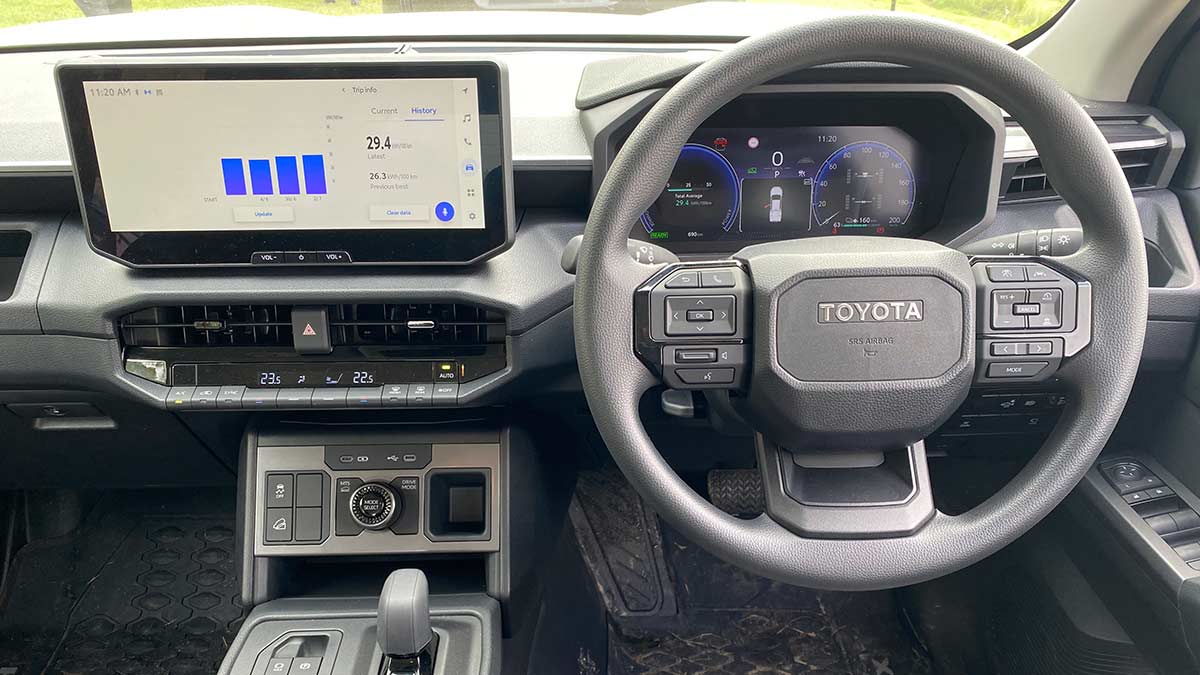
Large digital screens and a broad range of buttons are found across the Toyota HiLux BEV dash.
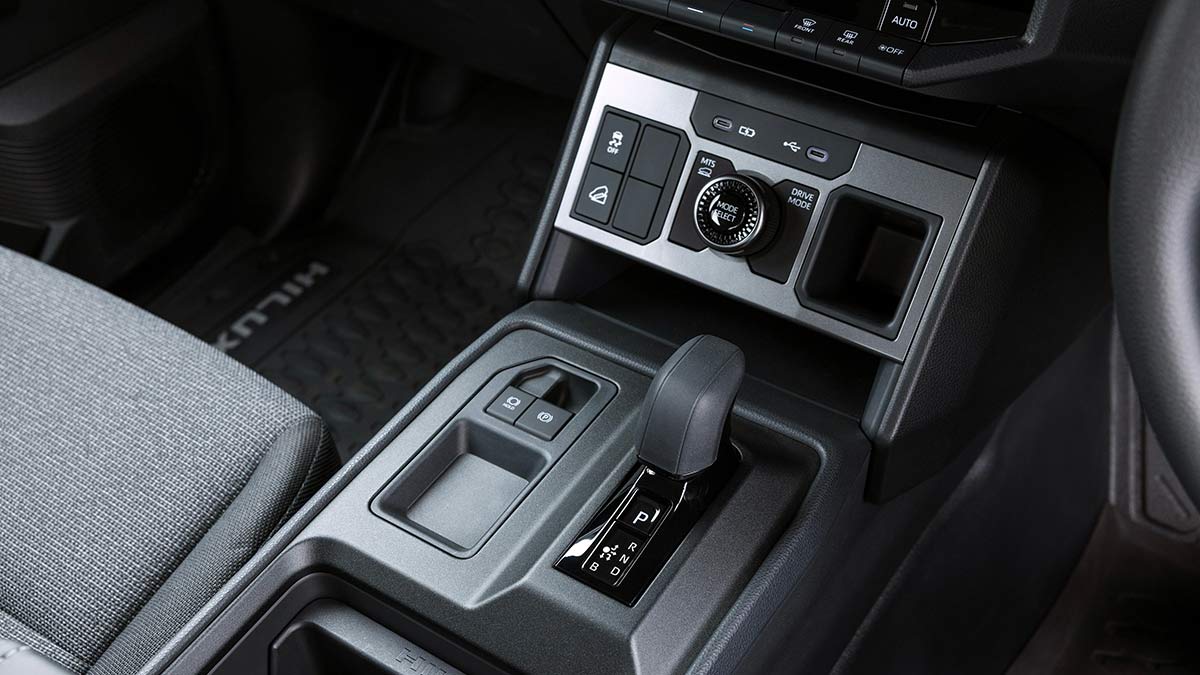
Toyota HiLux BEV console has a new shift controller and blank spaces where 4x4 switches are normally found.
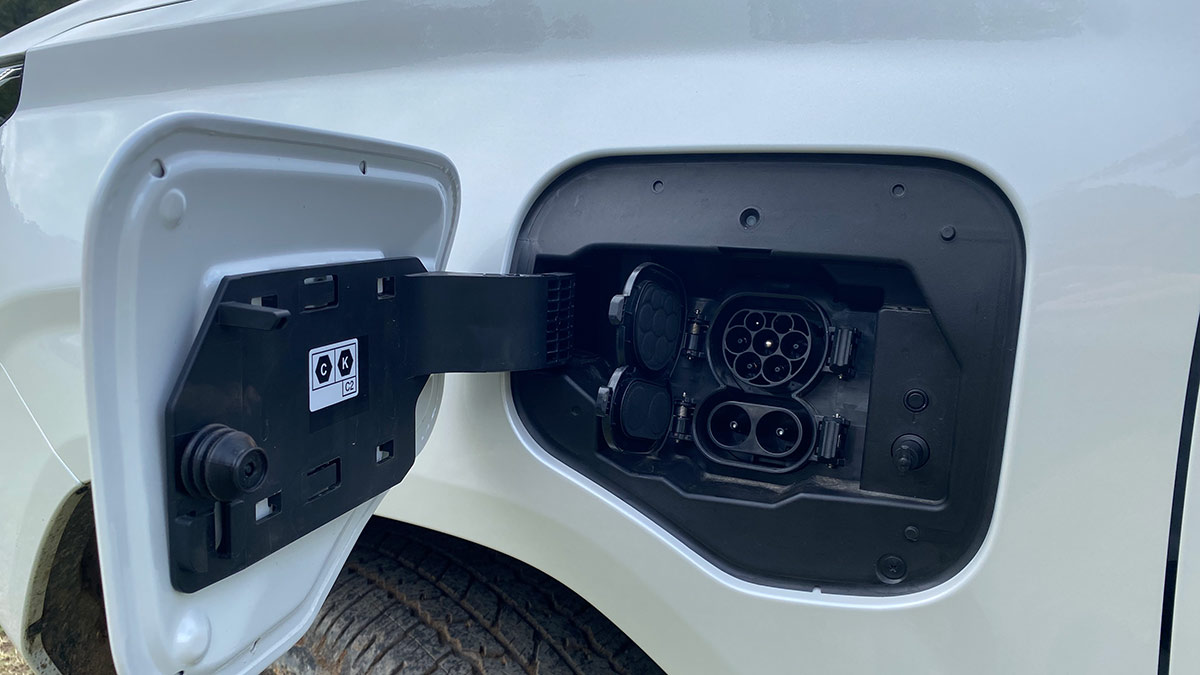
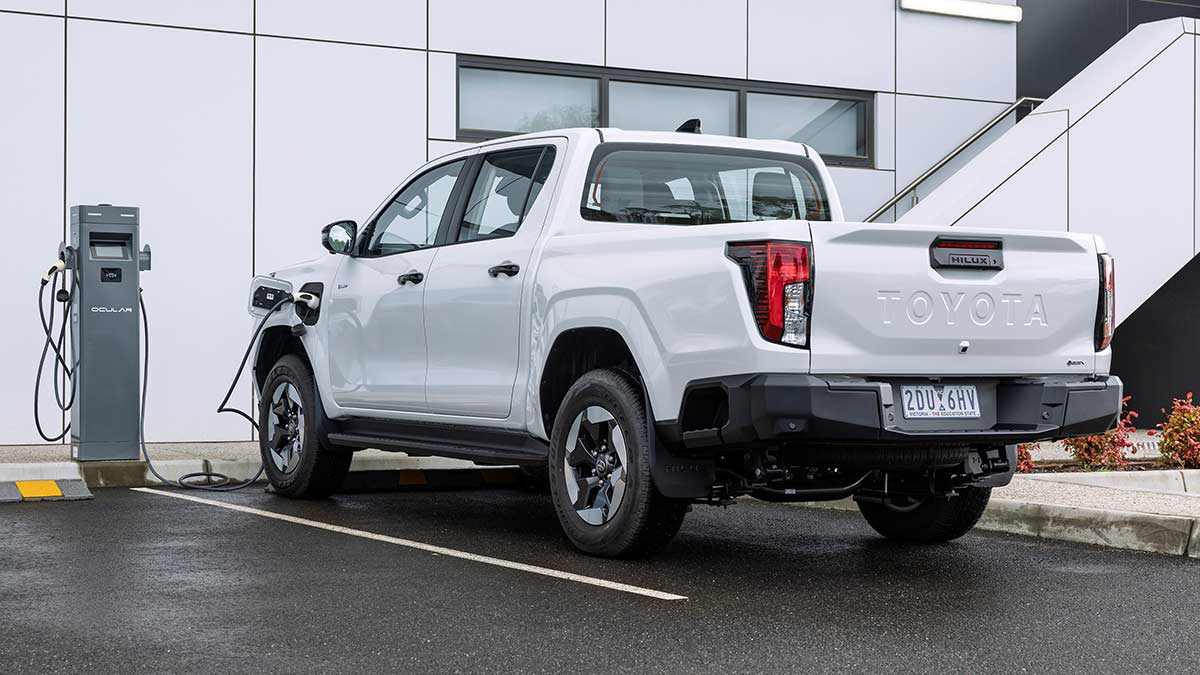
The Toyota HiLux EV needs at least half an hour to charge its battery from 10-80% using DC power.
1 of 3
What is the Toyota HiLux BEV like inside and out?
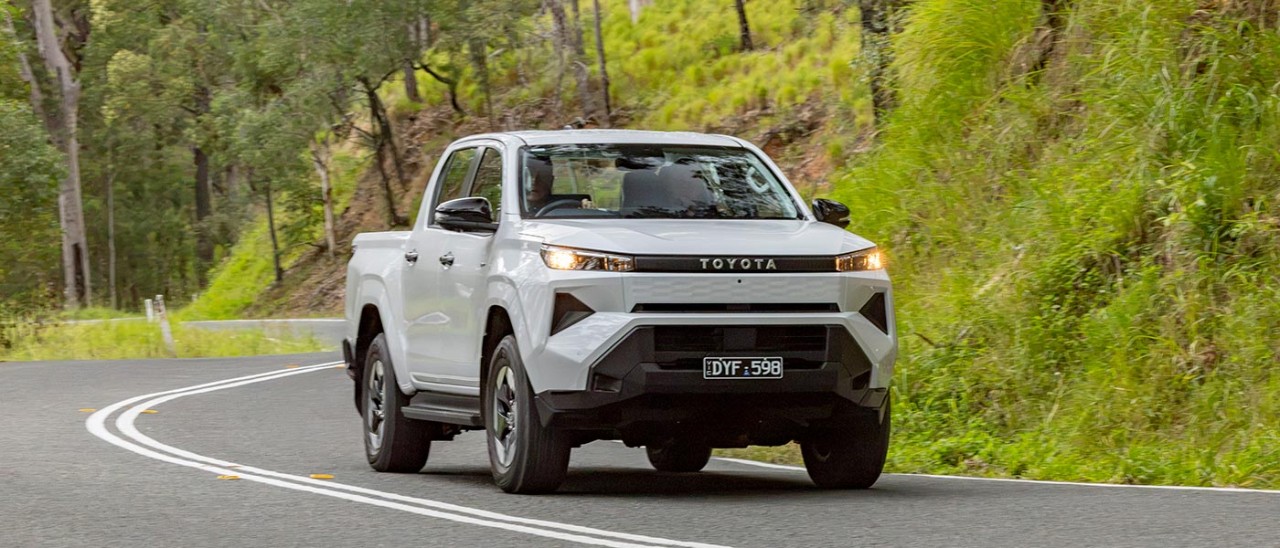
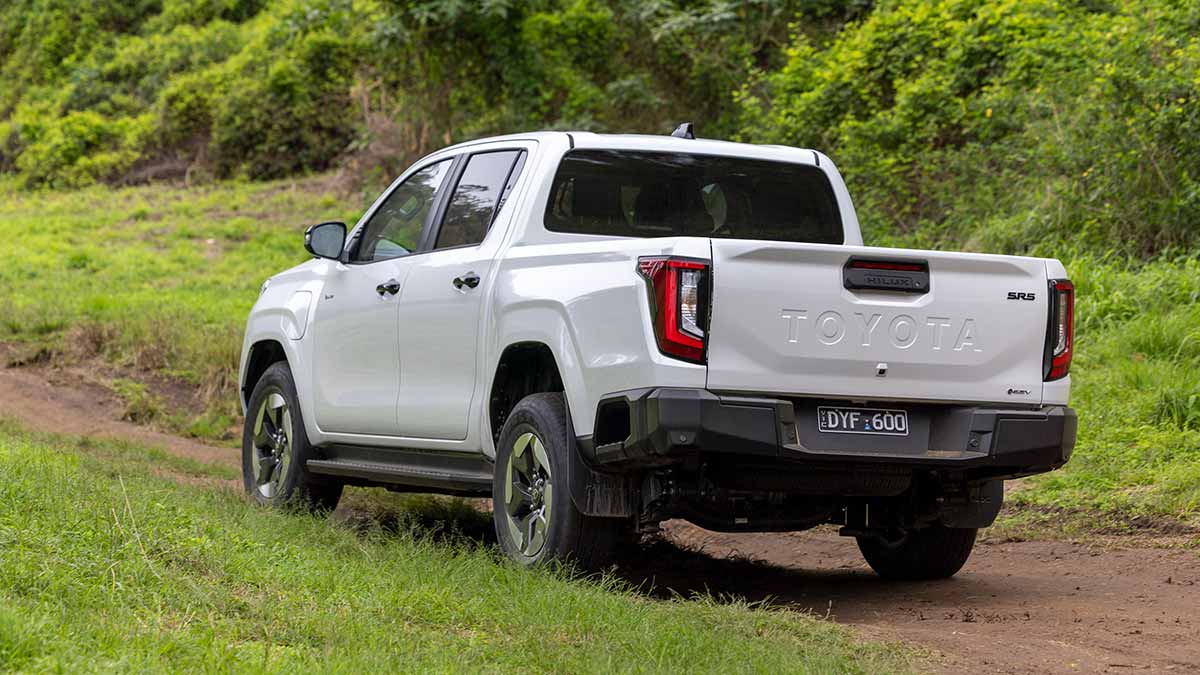
The 2026 Toyota HiLux BEV is still very much a member of the controversial-looking new-generation HiLux range, but you can tell it’s something different with its closed-off grille and the aerodynamic design of its 17-inch alloy wheels. The plastic wheelarch inserts on the regular ute have also been removed for better airflow.
Apart from that, there’s just some telltale badging at the rear of the EV and a big flap near the front end which covers the AC/DC battery charging ports.
Inside, the HiLux BEV models feature a unique 12.3-inch digital driver’s display with relevant gauges for EV performance, including the usual range and energy consumption figures, battery state of charge and graphics showing front/rear axle power distribution.
The shift-by-wire drive selector on the centre console is also new; the single-action controller takes some familiarisation, but it’s close to hand and presents no issues once mastered. Where diesel-powered SR variants use a traditional handbrake, an electronic park brake is fitted across the HiLux BEV range.
The electric AWD powertrain rules out traditional 4x4 mechanical hardware such as a dual-range transfer case and differential locks, so there’s a few blank buttons and a small storage hole on the centre dash stack where these controls are located on diesel models.
Otherwise, the interior fit-out and equipment levels for the SR and SR5 EVs are on par with their diesel counterparts. That’s quite basic in the SR, including vinyl floor coverings, urethane steering wheel, manual driver’s seat adjustment (no lumbar) and a basic four-speaker stereo, but at least there’s dual-zone climate control and the 12.3-inch colour touchscreen is standard.
The SR5 adds niceties like carpet, a wireless phone charger, four more speakers, heated front seats, power driver’s seat adjustment, auto-dipping rearview mirror, lidded glovebox, leather steering wheel trim, rear air vents, tinted windows, and more.
A 220V/1500W inverter in both BEV models supplies power to a three-pin domestic power point to run small appliances and power tools etc, but its position in the console box is awkward and would be better off in the tub or at the side of the ute.
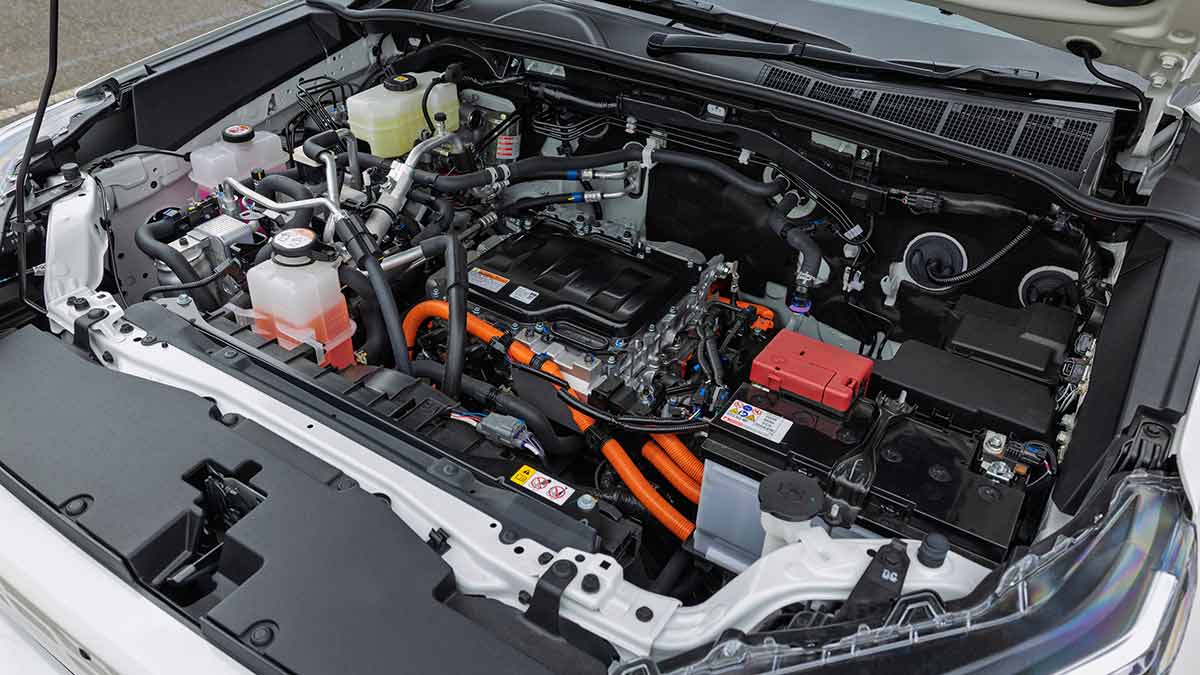
There is no storage space under the bonnet of the HiLux BEV, so charging cables must be stashed away in the cabin or the tray.
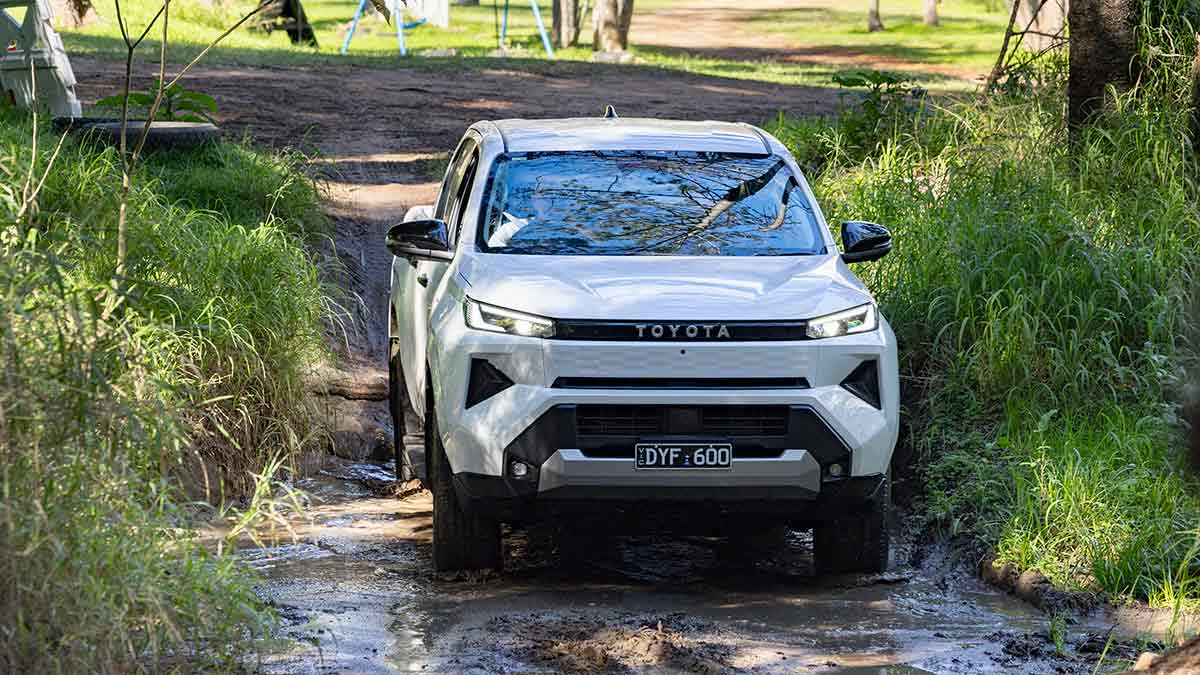
Toyota HiLux EV isn’t as well equipped as the diesel to handle rugged tracks, but it’s still competent off-road.
HiLux BEV is the first body-on-frame EV from Toyota.
Dual-motor powertrain in Toyota HiLux BEV was tested extensively by Australian mining companies.
1 of 3
How does the 2026 Toyota HiLux EV drive?
Replacing the diesel engine with twin electric motors in the 2026 Toyota HiLux BEV takes cabin quietness – and overall refinement – to a level we’ve never encountered in HiLux over multiple generations, which is something every ute owner should experience.
The silent treatment in this EV version is surreal, and while the long-serving diesel’s pulling power remains a strongpoint, the smooth and instantaneous response from the electric ute when accelerating from standstill puts HiLux BEV in a different league.
Driving the SR and SR5 pick-up versions, the HiLux EV isn’t what you’d call quick as it contends with a limited 144kW output and 2420-2455kg kerb weight, but it gets up and running with relative ease and proves effective in the cut and thrust of stop-start traffic. Higher-speed open-road stretches brought some wind noise to our attention, but we suspect that’s a flow-on effect from the absent diesel engine.
In keeping with its working class ethic, the electric HiLux features a leaf-sprung de Dion rigid axle that allows the EV components to be mounted onto the chassis frame to maintain good ground clearance and protection in rough terrain. The ride quality when unladen is jittery on lumpy back roads, just like the diesel.
Our drive included an off-road course designed to demonstrate how the HiLux EV – with no diff locks or low range, and with a lower 218mm ground clearance (-6mm) – was still capable, relying on its full-time AWD system and six-mode multi-terrain select electronics (auto, dirt, sand, mud, mogul, snow). It might not suit hard-core 4x4 enthusiasts, but did handle rutted tracks, steep inclines, downhill descents and a creek crossing without problem.
If all this is sounding like a death knell for diesel, we’re nowhere near that point.
As well as compromises made with its off-road performance, the HiLux EV has less payload capacity (down to 715kg on the SR5 BEV, compared to 985kg for the equivalent diesel), a lower maximum braked towing capacity (2000kg BEV vs 3500kg diesel) and a short driving range that not only limits the electric ute’s scope for towing trailers and caravans, but travelling much distance at all from home – even without a load.
Indeed, we couldn’t recommend caravanning or attempting weekend off-road treks with the battery-powered HiLux, which can theoretically only manage around 250km – unladen and unhitched – before needing to recharge (based on WLTP combined cycle testing conducted in a lab, not the real world). That’s for the pick-up; the cab-chassis has claimed 22% lower range, which was calculated without a tray fitted.
Toyota also claims that DC fast-charging the HiLux EV’s battery from 10-80% will take about 30 minutes in warm conditions (25 degrees Celsius) at the maximum 150kW rate, which is not always available at public charging stations, so be prepared for longer pitstops. AC charging up to 10kW at home, office or depot is said to take 6.5 hours.
The Toyota HiLux BEV is hamstrung by its limited driving range, claimed to be around 250km unladen (WLTP).
How safe is the electric Toyota HiLux BEV?
The 2026 Toyota HiLux EV qualifies for a maximum five-star ANCAP safety rating based on the assessment of the broader ninth-generation series, which was rated the safest ute for 2025. Additional testing, including frontal offset and oblique pole crash tests, were performed on the EV to confirm battery integrity and safety of high-voltage electrical systems.
This is Toyota’s first-ever body-on-frame battery-electric vehicle so plenty of work was carried out to integrate the battery into the chassis frame. The power pack fits between thicker and reinforced chassis rails, while the frame was beefed up with additional crossmembers.
Toyota says the battery subframe was designed to flex in order to tolerate the high levels of torsional input that occur when off-roading. It also has a cover at the bottom to protect high-voltage parts from water (when attempting creek crossings, for example) and other damage.
The Toyota Safety Sense suite of driver assist systems is included on all EV models, spanning autonomous emergency braking, active cruise control, lane trace assist/lane departure alert, emergency steering assist and speed sign recognition.
There’s also front and rear parking sensors, a panoramic view monitor, blind spot detection, safe exit assist, rear cross traffic alert and eight airbags, including a centre airbag between the front occupants and a driver’s knee airbag. Both HiLux EVs have an automatic high beam function, but the SR5 has higher-grade LED headlights compared to the SR.
Not least of all, Toyota’s connected services offering extends to automatic collision notification and SOS emergency call (eCall).
The 2026 Toyota HiLux EV might be pitched at mining companies and businesses that want to be seen as green, but the carmaker says it’s getting plenty of interest from mum-and-dad buyers.
That’s a real concern if these would-be owners with the best of intentions aren’t made aware of the compromises that come with the HiLux EV, which for a $17,000 premium brings more refinement than the diesel, and no tailpipe emissions, but few other advantages – and lots of drawbacks, too.
Sure, the electric ute is a useful tool of the trade for specific applications such as mining or short-distance, back-to-base work where the battery can be easily charged and efficiencies found.
For mum and dad, though, we’re hoping the sales staff at their local dealership give them the full facts before asking them to sign on the dotted line.
The information provided is general advice only. Before making any decisions please consider your own circumstances and the Product Disclosure Statement and Target Market Determinations. For copies, visit racv.com.au. As distributor, RACV Insurance Services Pty Ltd AFS Licence No. 230039 receives commission for each policy sold or renewed. Product(s) issued by Insurance Manufacturers of Australia Pty Ltd ABN 93 004 208 084 AFS Licence No. 227678.
Want more articles like this?
Subscribe to RACV News for advice on cars, safety, home and travel.